


The rapid advancement of artificial intelligence has ushered in a new era of autonomous systems that are reshaping how businesses operate.
AI agents, software entities capable of perceiving their environment, reasoning about tasks, and taking independent actions to achieve specific goals, represent a pivotal shift from traditional AI tools.
These agents go beyond simple chatbots or predictive models; they integrate with workflows, make decisions in real-time, and adapt to changing conditions without constant human oversight.
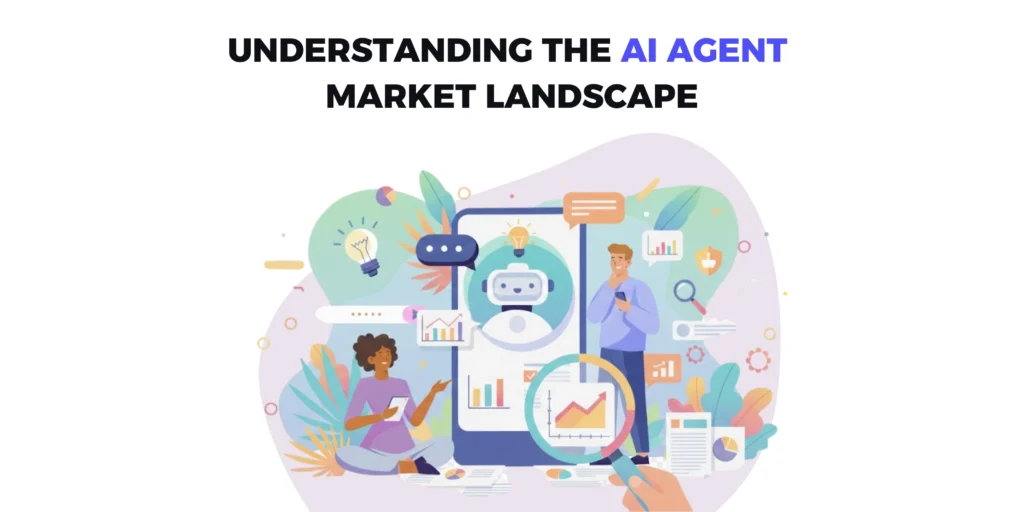
In this blog, we’ll explore the AI agent landscape in depth, examining its evolution, key components, and implications for enterprises. We’ll also delve into the AI agent market landscape, highlighting growth drivers, competitive dynamics, and emerging opportunities.
Drawing from industry reports and benchmarks, this analysis aims to provide a clear understanding of why AI agents matter, how they function, and the challenges they present. As organizations increasingly adopt these technologies, grasping their potential can inform strategic decisions in a fast-evolving digital economy.
According to recent surveys, adoption is accelerating: for instance, 62% of organizations are at least experimenting with AI agents, signaling a move toward broader implementation. This trend underscores the need for a nuanced view of the space, balancing innovation with practical considerations.
Evolution of AI Agents
AI agents have roots in early computing concepts, such as rule-based systems from the 1950s and 1960s, where simple algorithms followed predefined instructions to perform tasks.
However, the modern AI agent landscape began to take shape in the 2010s with advancements in machine learning and natural language processing.
The breakthrough came with large language models (LLMs) like those developed by OpenAI, which enabled agents to handle complex, multi-step processes.
By the mid-2020s, AI agents evolved from reactive tools, responding to user inputs, to proactive entities. This shift was driven by integrations with external APIs, allowing agents to interact with databases, tools, and even other agents.
For example, multi-agent systems emerged, where specialized agents collaborate on tasks, mimicking human teams. A key milestone was the integration of reinforcement learning, enabling agents to learn from outcomes and refine their behavior autonomously.
Why does this evolution matter? In practical terms, it solves longstanding problems in efficiency and scalability. Traditional automation required rigid scripting, but AI agents adapt to variability, such as fluctuating market conditions or customer queries.
Industry benchmarks from Forrester indicate that early adopters have seen up to 30% improvements in operational efficiency by deploying agents in areas like customer service and data analysis.
As the AI agent market landscape matures, this adaptability positions agents as essential for competitive advantage in knowledge-intensive industries.
Key Players in the AI Agent Market
The AI agent market landscape is characterized by a mix of established tech giants and innovative startups, each contributing to the ecosystem’s diversity.
Tech leaders like OpenAI, Google DeepMind, and Microsoft dominate through their foundational models and enterprise integrations. OpenAI’s agents, for instance, leverage GPT-series models for general-purpose tasks, while Google’s offerings emphasize scalability in cloud environments.
Specialized players are also gaining traction. Anthropic focuses on safety-aligned agents, addressing ethical concerns in deployment. Adept and Cerebras Systems stand out for their hardware-software synergies, optimizing agents for high-performance computing.
In the B2B space, companies like Salesforce integrate agents into CRM systems, enabling autonomous sales workflows.
Emerging firms add niche expertise. For voice-based applications, platforms like ContactSwing provide enterprise-grade AI voice agents that handle customer interactions, replacing traditional call centers with always-available, intelligent systems.
Startups such as Straive and LatentView Analytics target data-heavy industries, offering customizable agents for analytics and automation.
To illustrate the competitive dynamics, consider the following table summarizing select players based on focus areas and market positioning (drawn from industry analyses):
| Company/Platform | Focus Area | Notable Features | Market Position |
| OpenAI | General-purpose agents | Advanced reasoning, API integrations | Innovation leader |
| Google DeepMind | Enterprise scalability | Cloud-native, multi-modal capabilities | Strong in B2B adoption |
| Microsoft (Copilot) | Productivity tools | Workflow automation, collaboration | High enterprise penetration |
| Anthropic | Ethical AI agents | Safety guardrails, alignment mechanisms | Emerging in regulated sectors |
| Adept | Customizable automation | Developer tools, low-code interfaces | Rapid growth in startups |
These players collectively drive the market, with Gartner predicting that 40% of enterprise applications will embed task-specific AI agents by 2026, up from less than 5% in 2025.
This projection highlights the intensifying competition and the push toward specialized, value-driven solutions.
Current Trends in the AI Agent Landscape
The AI agent landscape is dynamic, with several trends shaping its trajectory. One prominent development is the rise of multi-agent collaboration, where systems of agents work together on complex tasks.
For example, in software development, one agent might handle coding while another manages testing, reducing project timelines by up to 40%, per McKinsey insights.
Integration with existing tools is another key trend. Agents are increasingly connecting to CRMs, ERPs, and external APIs, enabling seamless operations across platforms. This is particularly evident in industries like finance, where trading agents analyze market data in real-time, or healthcare, where diagnostic agents process patient records.
Ethical considerations and safety are gaining prominence. With agents handling sensitive decisions, frameworks for transparency and bias mitigation are essential. Reports from Harvard Business Review emphasize the need for “guardian agents” that oversee operations, projected to capture 10-15% of the agentic AI market by 2030.
Adoption varies by sector: Statista data shows finance and e-commerce leading, with agents driving personalized experiences. Overall, the AI agent market landscape reflects a shift toward agentic AI, where autonomy meets accountability, fostering sustainable growth.
Challenges and Opportunities
Despite promising trends, the AI agent landscape faces significant hurdles. Reliability in decision-making remains a concern; agents can err in unpredictable scenarios, leading to costly mistakes.
Gartner notes that over 40% of agentic AI projects may be canceled by 2027 due to implementation failures. Data privacy is another issue, especially under regulations like the EU AI Act, which demands robust safeguards.
High computational costs also pose barriers. Training and running advanced agents require substantial resources, limiting access for smaller firms. Additionally, integration challenges arise when agents interact with legacy systems, often requiring custom development.
Yet, these challenges create opportunities. For instance, addressing reliability through better reinforcement learning can unlock efficiency gains, with Pew Research highlighting potential job creation in AI oversight roles.
The democratization of tools via open-source platforms lowers entry barriers, enabling broader innovation. In the AI agent market landscape, organizations that navigate these issues, reimagining operations as human-agent hybrids, stand to gain, as Deloitte reports suggest leading firms are already seeing operational redesign benefits.
Future Outlook for the AI Agent Market
Looking ahead, the AI agent market landscape is poised for exponential growth. Projections from industry sources estimate the global market expanding from approximately $7.8 billion in 2025 to over $52 billion by 2030, at a compound annual growth rate (CAGR) of around 40%.
This surge will be fueled by advancements in multimodal AI, allowing agents to process text, images, and voice seamlessly.
Emerging technologies like edge computing will enable real-time agents in sectors such as autonomous vehicles and IoT. Forrester anticipates that by 2028, 90% of B2B buying could be AI-agent intermediated, pushing trillions in spend through these systems.
However, this future hinges on resolving ethical dilemmas, with increased focus on governance from bodies like government AI initiatives.
In summary, the outlook is optimistic yet cautious: AI agents will likely become ubiquitous, transforming workflows, but success depends on balanced innovation and regulation.
Conclusion
The AI agent landscape and AI agent market landscape reveal a field ripe with potential, from evolutionary advancements to practical applications across industries.
Key learnings include the shift toward autonomous, collaborative systems that enhance efficiency while addressing real-world challenges like privacy and reliability.
Practically, this means businesses should prioritize pilot programs, focusing on integration and ethical frameworks to realize value. Looking forward, as adoption scales, AI agents could redefine work, creating hybrid human-AI ecosystems that drive innovation through 2030 and beyond.
FAQs
What exactly is an AI agent?
An AI agent is an autonomous software system that perceives its environment, reasons about goals, and executes actions independently. Unlike basic AI tools, agents handle multi-step tasks, adapting to changes, which makes them ideal for complex workflows in business settings.
How does the AI agent market differ from general AI?
The AI agent market focuses on practical, goal-oriented systems integrated into operations, whereas general AI encompasses broader technologies like machine learning. Agents emphasize autonomy and tool usage, leading to targeted applications in areas like customer service or finance.
What are the main risks in deploying AI agents?
Key risks include decision-making errors in uncertain scenarios, data privacy breaches, and high implementation costs. Organizations can mitigate these through robust testing, compliance with regulations like the EU AI Act, and phased rollouts to ensure reliability.
Why are multi-agent systems gaining popularity?
Multi-agent systems allow specialized agents to collaborate on tasks, improving efficiency for complex problems. This trend solves scalability issues in single-agent setups, with industry reports showing up to 40% faster project completion in fields like software development.
How will AI agents impact jobs?
While agents automate routine tasks, they create opportunities in AI oversight and strategy roles. Benchmarks suggest a net positive effect, with human-agent hybrids enhancing productivity rather than fully replacing workers, as seen in early enterprise adoptions.
What role do ethics play in the AI agent landscape?
Ethics ensure agents are transparent, unbiased, and safe. Frameworks like guardian agents monitor operations, addressing concerns in regulated industries. This focus is crucial for trust, with projections indicating ethical tools capturing significant market share by 2030.
Are AI agents suitable for small businesses?
Yes, with low-code platforms and cloud integrations making them accessible. Small firms can start with niche agents for tasks like customer support, achieving cost savings of 20-30% without extensive resources, per industry standards.
How is the AI agent market expected to grow?
The market is projected to reach $52 billion by 2030 from $7.8 billion in 2025, driven by enterprise adoption. Growth areas include B2B processes, with 40% of apps embedding agents by 2026, highlighting a shift toward autonomous operations.
What industries benefit most from AI agents?
Finance, healthcare, and e-commerce lead, using agents for trading, diagnostics, and personalization. These sectors see efficiency gains of up to 30%, as agents handle data-intensive tasks, per reports from research firms like Gartner.
How can organizations prepare for AI agent adoption?
Start with assessing workflows for automation potential, invest in data quality, and build interdisciplinary teams. Pilot programs with measurable KPIs, combined with training on ethical use, ensure smooth integration and long-term success.