


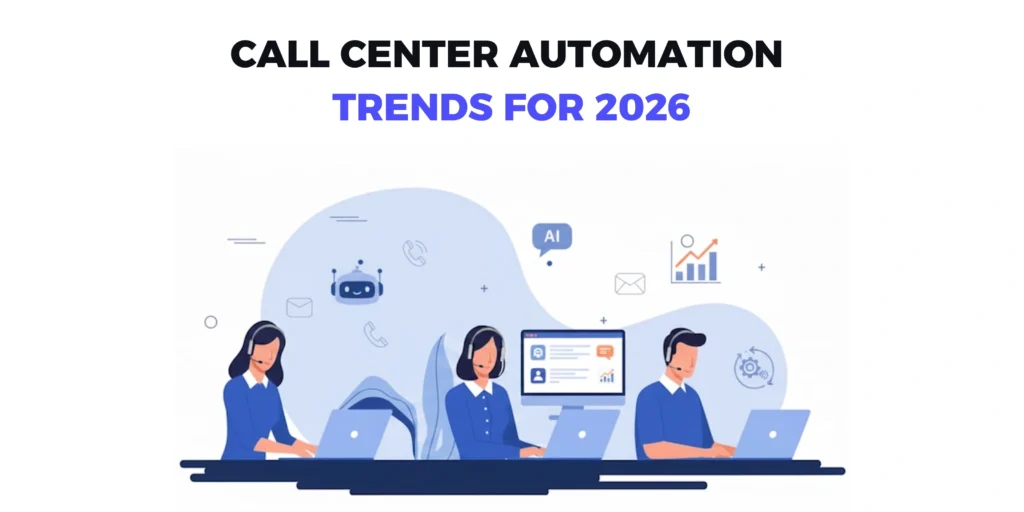
Call centers are undergoing a drastic reset. The old model was built for a world where “support” meant answering questions, logging a ticket, and moving to the next call. The modern model is built for outcomes: resolve the issue, retain the customer, protect revenue, and capture clean data that improves future interactions. That’s why automation is no longer treated like a bolt-on chatbot project. It’s becoming the operating system for the contact center.
The biggest shift is integration and accountability. Leaders now expect every conversation to connect to the systems that run the business, especially the customer relationship management system (CRM). When a customer calls, the agent or AI should already know who they are, what they bought, what happened last time, and what the next best action is. When the call ends, the CRM should be updated automatically, follow-ups should be triggered, and the interaction should feed reporting and quality workflows. Efficiency and return on investment are the new language: lower handle time, fewer transfers, more first-call resolution, and measurable savings without sacrificing experience.
Keeping that in mind, how can we talk about a revolution without talking about what trends are shaping the revolution?
Trend 1: Agentic AI That Completes Work, Not Just Conversations
The old model was simple: a bot chats, then hands off to a human. And dare I say, it worked for many MANY years.
The new model is agentic automation that can follow a plan, use tools, and complete steps like refunds, bookings, eligibility checks, or account updates within defined guardrails.
This shift matters because it attacks the real cost driver in support: “partial resolution.” When customers get bounced between systems, they call again, escalate, or churn. Agentic AI reduces the number of interactions needed to get a final outcome.
A practical way to spot agentic AI in the wild: it does not just say “I can help,” it actually performs actions like updating records or triggering workflows and then confirms completion.
Trend 2: Real-Time Agent Assist Becomes The Default
Agent assist used to be a “nice add-on.” Now it is becoming the baseline expectation: AI listens to the call, summarizes context, surfaces relevant knowledge, and suggests next-best actions while the conversation is still happening.
This trend is growing because it improves performance without changing your operating model. You do not need to replace your team or rebuild your tech stack to see value; you enhance every call your humans already take. This is AI
A useful stat to frame this trend: a Five9 survey referenced by CX Today said 94% of business leaders are using AI to support agents in real time during customer interactions.
Trend 3: Voice Bots Replace “Press 1 For Billing” IVR Trees
Rigid Interactive Voice Response (IVR) menus are losing ground to natural language voice automation. Instead of forcing customers to navigate a menu tree, AI voice agents ask what the caller needs and route or resolve based on intent.
This is not just a cosmetic improvement. Natural language front-ends reduce misroutes, shorten handle time, and cut abandonment because customers feel like they are progressing rather than “fighting the phone system.” Plus, customers feel actually heard- which is the most important aspect of customer satisfaction.
Voice bots are also expanding beyond inbound routing into end-to-end resolution for simple tasks, especially where the data and workflows are well-defined.
Trend 4: Omnichannel Orchestration Replaces One-Off Automations
Most companies already have multiple channels: phone, chat, email, SMS, and social. The trend now is orchestration, meaning one continuous customer journey across channels rather than siloed automations that restart every time the channel changes.
What changes operationally is the concept of context. The system carries customer history, intent, and status from chat to voice to email, so the customer does not repeat themselves, and the agent does not start from zero. Multiple touchpoints that carry the same context.
This is where automation stops being “a bot” and starts being “a coordinated service system.” It also creates cleaner analytics because the journey is connected, not fragmented.
Trend 5: Automated Quality Assurance Expands From Sampling To Coverage
Traditional Quality Assurance (QA) is expensive because humans can only review a small sample of calls. Automation is pushing QA toward broader coverage by scoring more interactions for compliance, tone, script adherence, and outcome quality.
This changes coaching. Instead of waiting for a monthly QA review, managers can spot patterns quickly: where agents struggle, which policies trigger confusion, or which call types spike refunds or escalations. Each call is recorded, insights generated, and even live support and input on ‘what to say next’ is available in modern AI contact centre support systems.
It also reduces inconsistency. When evaluation criteria are clearer and more systematic, coaching becomes less subjective and more repeatable across teams.
Trend 6: Predictive Routing And Forecasting Gets Much Smarter
Workforce management used to be a spreadsheet and a prayer. Automation increasingly forecasts call volumes, identifies peaks, and routes customers to the best agent based on intent, history, and probability of resolution.
Predictive routing is not only about speed. It is about fit: matching complex issues to skilled agents, routing high-value customers to experienced teams, and reducing transfers that frustrate callers.
The organizations that win here treat routing as a conversion problem. The goal is not “answer faster,” it is “resolve faster with fewer handoffs.”
Trend 7: Analytics Shifts From Dashboards To Decisions
A lot of contact centers have reporting. Fewer have decision-grade insight. The trend is moving from “what happened” dashboards to systems that classify calls automatically, detect sentiment, and highlight what you should change next.
Speech analytics and conversation intelligence are increasingly used to surface product issues, policy confusion, competitor mentions, and churn signals directly from call transcripts. AI contact centre tools actively tell you insights based on all the calls you’ve had in a certain period.
This turns the contact center into a listening engine for the business. You stop treating calls as “cost” and start treating them as high-density feedback.
Trend 8: Security, Privacy, And Compliance Become Mandatory Design Constraints
As automation becomes more autonomous, security and compliance stop being a checklist at the end. They become design constraints at the beginning. If you’re going to make people use AI systems, you’d better ensure that their data is safe.
This trend shows up in stricter controls around data access, retention, logging, and how models interact with customer information. It also shows up in more emphasis on governance: who can change workflows, how changes are audited, and how failures are handled.
In practice, the best teams build automation that is powerful but bounded. They decide which actions are allowed, which require confirmation, and which must be escalated to humans.
Practical Use Cases To Tie It Together
To keep these trends from feeling abstract, here are a few “real contact center” patterns they enable:
- High-volume FAQs resolved end-to-end by voice AI, with agent assist supporting edge cases.
- Omnichannel journeys where a chat conversation becomes a voice call without losing context.
- Automated QA that flags compliance risks the same day, not weeks later.
- Predictive routing that reduces transfers by sending the right calls to the right teams immediately.
Key Takeaways
- Contact centers are shifting from “bots that answer” to agentic systems that resolve tasks end-to-end.
- Real-time agent assist is becoming the default layer of automation in modern operations.
- Natural language voice bots are replacing old IVR trees and reducing friction in routing and resolution.
- Omnichannel orchestration, automated QA, predictive routing, and decision-grade analytics are becoming core capabilities, not extras.
FAQs
What’s The Fastest Automation Win For Most Call Centers?
Real-time agent assist tends to deliver fast value because it improves every call without requiring full end-to-end automation.
What’s The Biggest Mistake Teams Make With Automation?
Teams automate channels instead of automating outcomes, which creates bots that talk but do not resolve.
What Should Be Automated First: Voice Or Chat?
Voice automation is usually the priority when call volume is high, and abandonment is a problem, while chat automation is often easier for structured FAQs.
Is Complete Automation Possible?
While complete automation of call centres is possible with modern systems theoretically, it is usually advised against. However small, you still need a human team to ensure escalated matters are handled with extreme care, and that the AI systems do not make a mistake that goes unnoticed.