


Real estate agents and brokerages handle thousands of leads annually from online portals, website forms, open houses, and referrals, yet only a small fraction convert into transactions.
Studies show that up to 90% of leads go cold due to delayed or misdirected follow-up, while agents waste time on unqualified prospects. Predictive lead scoring addresses this by using data to forecast which leads are most likely to buy or sell soon.
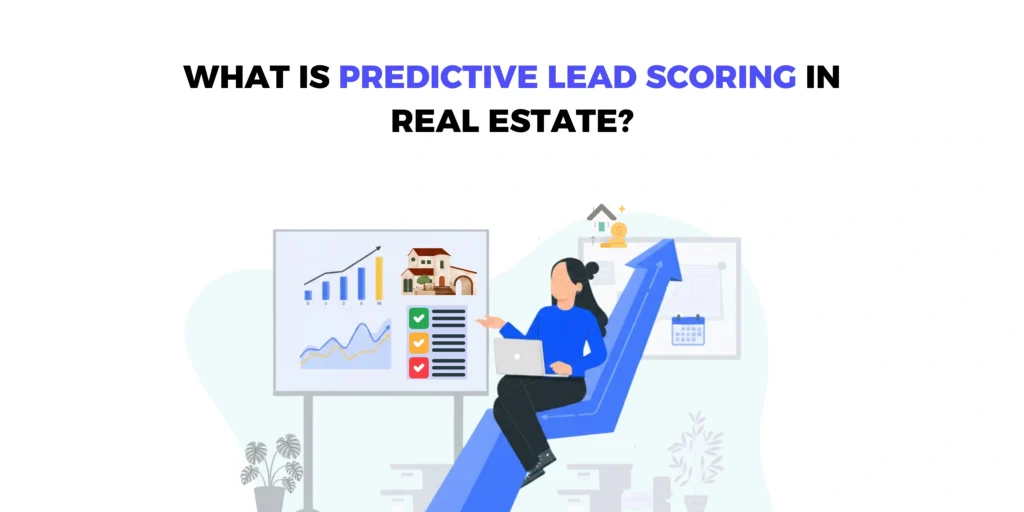
What is predictive lead scoring? It is a method where predictive lead scoring machine learning analyzes historical data, behavioral signals, and demographic details to assign each lead a score indicating conversion probability, often on a 0-100 scale.
In the real estate business, a predictive lead scoring algorithm in real estate business processes factors like property search history, budget indicators, and market trends to rank leads automatically.
This approach differs from traditional scoring, which relies on simple rules. AI predictive lead scoring incorporates machine learning for more accurate predictions.
The global predictive lead scoring software market reached USD 1.2 billion in 2022 and is projected to grow at a CAGR of 22.5% through 2030, with real estate among key adopters due to high lead volumes. Platforms like Offrs achieve 72% accuracy in predicting homeowners likely to sell.
This guide explains predictive lead scoring, how predictive lead scoring machine learning functions, applications in real estate, benefits supported by data, challenges, implementation, and future developments.
What Is Predictive Lead Scoring?
Predictive lead scoring uses machine learning to evaluate leads based on patterns from past conversions, rather than fixed rules. Traditional scoring assigns points for actions like email opens or form submissions, but predictive lead scoring algorithm examines vast datasets to predict outcomes.
In real estate, predictive lead scoring in real estate scores leads on likelihood to transact within months. It draws from sources like property views, search frequency, financing pre-approvals, and public records on homeownership duration. Scores typically range 1-100, with high scores (e.g., 80+) signaling readiness.
Evolution moved from manual qualification to rule-based systems in CRMs, then to AI predictive lead scoring in the 2010s with big data and machine learning. Today, over 72% of real estate firms use predictive analytics for opportunities.
Core components include data sources (CRM history, website analytics, external databases), feature engineering (behavioral signals like repeated visits), and models trained on converted vs. non-converted leads.
Unlike rule-based methods missing nuances, predictive lead scoring machine learning adapts continuously, improving accuracy as data grows. In real estate, it identifies off-market sellers or serious buyers early, giving agents an edge.
How Predictive Lead Scoring Machine Learning Works
Predictive lead scoring machine learning follows a structured process to turn raw data into actionable scores.
Data Collection & Feature Engineering
Systems gather explicit data (budget, location preferences) and implicit signals (page views, time on site, email interactions). In real estate, this includes MLS searches, virtual tour views, and external factors like life events from public records.
Feature engineering creates variables, such as “search intensity score” from visit frequency.
Model Training
Supervised learning trains on labeled data, past leads marked “converted” or “not.” Models learn patterns, like high engagement plus pre-approval correlating with 4x conversion.
Common Algorithms
- Logistic Regression – For basic probability estimates.
- Random Forest – Handles complex interactions.
- Gradient Boosting (e.g., XGBoost) – Popular for accuracy in real estate predictions.
- Neural Networks – For large datasets with behavioral depth.
Platforms like Revaluate or Offrs use ensembles for 70-80% accuracy.
Scoring Output & Thresholds
New leads receive scores in real-time. Thresholds categorize: 80+ for immediate contact, 50-79 for nurturing.
Continuous Learning & Model Retraining
Models retrain periodically with new conversions, maintaining relevance amid market shifts.
(Suggestion: Include a flowchart showing data input → model → score → CRM action.)
Predictive Lead Scoring Algorithm in Real Estate Business – Key Applications
A predictive lead scoring algorithm in real estate business applies across scenarios, with adoption yielding 3-5x conversion lifts in cases.
- Prioritizing Inbound Leads from Portals (Zillow, Realtor.com): Scores portal leads by engagement depth. One national brand saw 4x conversion from top-scored leads.
- Scoring Website and Landing Page Visitors: Tracks anonymous behavior until identification, predicting intent. Offrs identifies likely sellers with 72% accuracy.
- Nurturing Long-Tail Luxury or Commercial Leads: Handles slower cycles by monitoring subtle signals, improving ROI on high-value prospects.
- Agent Assignment & Territory Optimization: Routes high scores to specialized agents, boosting close rates.
- Predicting Buyer vs. Seller Intent: Distinguishes types from search patterns, as in SmartZip’s territory scoring.
- Integration with CRM (Follow Up Boss, BoomTown, Salesforce): Pushes scores for automated workflows, like alerts for rising scores.
These uses help focus on the 10-20% of leads driving most transactions.
Benefits of AI Predictive Lead Scoring in Real Estate
AI predictive lead scoring delivers measurable gains:
- Higher Conversion Rates → Top-scored leads convert 3-4x better; businesses see over 50% lifts.
- Reduced Response Time to Hot Leads → Real-time scoring enables contact within minutes, critical as 90% expect quick replies.
- Lower Cost Per Acquisition → Focuses marketing on high-potential, cutting waste.
- Better Resource Allocation for Agents → Frees time from cold leads.
- Improved ROI on Marketing Spend → Targeted campaigns yield higher returns.
Overall, it shortens cycles and aligns teams.
Challenges & Limitations
Challenges include:
- Data Quality and Quantity Requirements – Needs thousands of past leads for accuracy; poor data lowers predictions.
- Model Bias and Fairness – Historical biases may skew scores; regular audits required.
- Privacy and Compliance (CCPA, GDPR) – Handling personal data demands consent and security.
- Integration Complexity with Legacy Systems – Older CRMs complicate setup.
- Over-Reliance Risk and False Positives/Negatives – Scores inform, not replace, judgment.
Mitigations: Start with clean data, use diverse training sets, audit models, ensure compliant vendors.
How to Implement Predictive Lead Scoring in Real Estate
Here are steps to Implement Predictive Lead Scoring in Real Estate:
- Assess Data Readiness – Compile 12+ months of CRM history.
- Choose Tools/Models – Off-the-shelf (Offrs, Revaluate) or custom via platforms like HubSpot.
- Pilot and Validate – Test on subset, measure lift vs. control.
- Train Teams – Educate on interpreting scores.
- Monitor and Iterate – Retrain quarterly, adjust thresholds.
Small teams start affordably with integrated CRM tools.
Predictive Lead Scoring in Real Estate
Multimodal data (voice calls, video views) and real-time scoring will dominate. Agentic AI may automate initial outreach. Market growth to billions reflects rising adoption, with accuracy climbing via better models.
ContactSwing provides AI voice agents that work alongside predictive lead scoring systems in real estate. These agents handle initial calls to high-scoring leads, qualify details through conversation, update CRM records instantly, and book viewings, allowing agents to respond quickly while complying with privacy rules.
Key Takeaways
Predictive lead scoring transforms real estate lead management by using predictive lead scoring machine learning to forecast conversions accurately.
From defining what is predictive lead scoring to applications like portal prioritization, a predictive lead scoring algorithm in real estate business drives higher conversions and efficiency.
AI predictive lead scoring offers clear advantages but requires quality data and oversight. As adoption grows, it becomes essential for competitive agents handling modern lead volumes.
FAQs
What is predictive lead scoring?
Predictive lead scoring uses machine learning to analyze historical and behavioral data, assigning leads scores based on conversion likelihood. In real estate, it predicts buyers/sellers with 70-80% accuracy, far outperforming manual methods.
How does predictive lead scoring machine learning work?
It collects data, engineers features, trains models (e.g., Gradient Boosting) on past conversions, scores new leads in real-time, and retrains periodically. Accuracy improves with more data, often reaching 72% for seller predictions.
What algorithms are used in predictive lead scoring?
Common ones include Logistic Regression for basics, Random Forest for interactions, and Gradient Boosting for high accuracy. Neural networks handle complex real estate behavioral data in advanced platforms.
How effective is AI predictive lead scoring in real estate?
It boosts conversions 3-4x for top scores and over 50% overall. Platforms like Offrs achieve 72% accuracy in identifying likely sellers, reducing wasted effort on cold leads.
What data is needed for a predictive lead scoring algorithm?
Historical conversions, behavioral signals (searches, views), demographics (budget, location), and external records (ownership duration). At least 1,000+ labeled leads ensure reliable training.
Can small real estate teams use predictive lead scoring?
Yes, affordable tools like integrated CRM add-ons or platforms (Revaluate, SmartZip) start under subscription models. They require minimal data and scale with team size.
What’s the difference between traditional and predictive lead scoring?
Traditional uses fixed rules and points; predictive applies machine learning to patterns from data, adapting dynamically and achieving higher accuracy (up to 4x conversion lift).
How long does it take to implement predictive lead scoring?
Initial setup: 4-8 weeks for data integration and training. Full benefits appear after 3-6 months of retraining and validation on live leads.
Is predictive lead scoring compliant with privacy laws?
Compliant tools follow CCPA/GDPR via consent-based data use and anonymization. Choose vendors with built-in safeguards to handle personal information responsibly