


In the competitive world of real estate, where buyers and sellers demand immediate responses, delays can mean lost opportunities.
Research indicates that 78% of potential clients expect a reply within five minutes of an inquiry, yet traditional agent follow-ups often take hours or days, leading to up to 80% of leads going cold. This gap is where conversational AI in real estate steps in, offering round-the-clock, natural-language interactions that mimic human conversation through text or voice.
Conversational AI in real estate encompasses systems powered by natural language processing (NLP) and machine learning that handle inquiries, qualify prospects, and guide users through property searches.
Unlike basic rule-based tools, these systems understand context, intent, and nuances, providing personalized responses. For real estate agents, conversational AI for real estate agents means tools that operate as virtual assistants, capturing leads from websites, social media, or phone calls without interrupting workflows.
The broader AI in real estate market is projected to reach $301.58 billion in 2025, growing at a compound annual growth rate (CAGR) of 34.1% to $975.24 billion by 2029, with conversational interfaces playing a key role in customer engagement.
Adoption is surging: 68% of agents now use AI tools, up significantly from prior years, driven by efficiency gains estimated at $34 billion industry-wide by 2030. Meanwhile, the global conversational AI market itself is valued at $12.82 billion in 2025, expanding to $136.41 billion by 2035 at a 23.98% CAGR, fueled by demand for instant, scalable interactions.
This guide breaks down conversational AI in real estate: its fundamentals, mechanics, applications, benefits supported by data, challenges, implementation steps, and emerging trends.
Whether you’re a solo agent or part of a brokerage, understanding conversational AI real estate tools equips you to meet client expectations in a digital-first market.
What Is Conversational AI in Real Estate?
Conversational AI in real estate refers to intelligent software that enables machines to engage in human-like dialogues with users via text, voice, or hybrid channels.
At its core, it goes beyond simple scripted responses, using advanced algorithms to interpret queries, maintain context across interactions, and deliver relevant outputs. In the real estate sector, this translates to AI chatbots real estate that answer questions about listings, while voice AI real estate handles phone-based tours or financing discussions.
The distinction from traditional chatbots is key: early bots relied on predefined rules and keyword matching, often failing on complex or off-script inputs. Modern real estate conversational AI, however, employs NLP for understanding semantics, natural language understanding (NLU) for intent detection, and dialogue management for multi-turn conversations.
For instance, an AI voice agents real estate might start with “What type of home are you seeking?” and follow up with tailored suggestions based on budget or location preferences.
Evolution traces back to basic FAQ bots in the 2010s, but by 2025, integration of large language models (LLMs) like those powering ChatGPT has made systems more adaptive.
Types include:
- Text-based AI chatbots real estate: Embedded on websites for instant messaging.
- Voice AI real estate: Handling calls via speech-to-text and text-to-speech.
- Omnichannel real estate conversational AI: Seamless across email, SMS, apps, and social platforms.
Over 77% of real estate professionals anticipate significant AI impacts within five years, with conversational tools leading in client-facing roles. Companies like Zillow and Redfin exemplify this, using conversational AI real estate to personalize searches and boost efficiency.
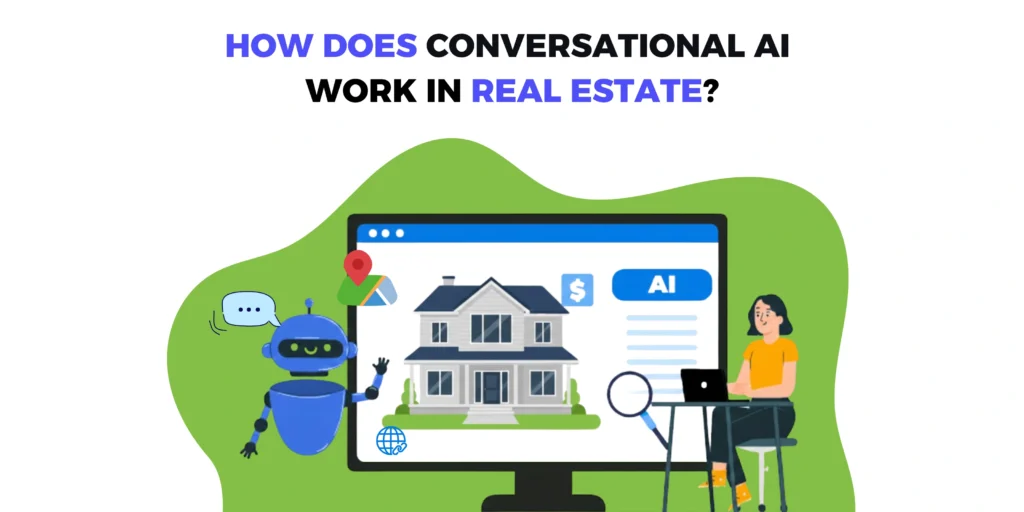
How Conversational AI Works in Real Estate?
Conversational AI in real estate operates through a layered architecture that processes inputs, generates responses, and learns from interactions.
Here’s a step-by-step overview.
User Input Processing (Text/Voice)
Interactions begin with capturing user data. For text, AI chatbots real estate parse messages from website widgets or apps.
Voice AI real estate uses automatic speech recognition (ASR) to convert spoken words to text, handling accents and background noise with up to 95% accuracy in modern systems.
Preprocessing cleans inputs, tokenizing words and identifying entities like “3-bedroom in downtown.”
Intent Recognition & Context Management
NLU then classifies intent, e.g., “schedule viewing” vs. “compare prices”, using machine learning models trained on real estate datasets. Context is tracked via session memory, recalling prior details like a user’s stated budget.
In conversational AI for real estate agents, this prevents repetitive questions, maintaining fluid dialogues.
Response Generation & Personalization
Generative models, often LLMs, craft responses drawing from knowledge bases of listings, market data, and FAQs.
Personalization pulls from user profiles: “Based on your interest in family homes, here’s a 4-bed option under $500K.” Outputs are scored for relevance before delivery.
Integration with CRM/MLS
Responses sync with customer relationship management (CRM) systems like Follow Up Boss or multiple listing services (MLS).
High-intent leads trigger alerts, updating records in real-time. Tools like HubSpot integrate conversational AI real estate for automated nurturing.
Handover to Human Agents
If complexity exceeds AI limits, e.g., emotional negotiations, seamless escalation occurs, passing context to agents.
This hybrid model ensures 70-80% of routine queries are resolved autonomously.
Key Applications of Conversational AI in Real Estate
Conversational AI in real estate spans lead management to post-sale support, with real-world implementations showing tangible results.
- Lead Qualification & Capture 24/7: AI chatbots real estate engage site visitors instantly, asking qualifying questions like budget or timeline. Save Max Canada reported a 62% faster lead response rate using such tools, increasing volume without added staff. Ylopo’s AI Voice has logged over 25 million conversations with 48% response rates.
- Property Search & Recommendations: Users describe needs (“spacious yard near schools”), and real estate conversational AI queries databases for matches, explaining features. RedfinBot personalizes suggestions, enhancing user satisfaction.
- Scheduling Viewings & Open Houses: Voice AI real estate checks calendars and books slots via integrations like Calendly. Notar in Norway saw a 15% rise in showings through automated booking. EliseAI handles this across channels for property managers.
- Answering FAQs (Pricing, Neighborhoods, Financing): Systems deflect 40% of routine queries, freeing agents. Century 21’s Sofia guides users on listings and connects to experts.
- Follow-Up & Nurturing Campaigns: Post-interaction, AI sends tailored emails or texts. Compass Concierge nurtures via ongoing chats, boosting engagement.
- Buyer/Seller Intent Detection: NLP analyzes sentiment to score readiness. Roof AI routes qualified leads, reducing manual triage.
- Multilingual Support for Diverse Markets: Handles queries in multiple languages, expanding reach in global cities.
These applications drive 15-30% higher conversion rates within months.
Benefits of Conversational AI for Real Estate Agents
Conversational AI for real estate agents yields data-backed advantages:
- 24/7 Availability: Captures 30-50% more leads outside hours, as 90% of consumers expect conversational tools.
- Faster Response Times: Achieves 62% quicker replies, with 80% of customers prioritizing speed. This triples conversions.
- Reduced Agent Workload: Automates 70-80% of routine tasks, cutting screening time by 75%.
- Improved Lead Quality: Qualification yields 3x better prospects.
- Higher Customer Satisfaction: Personalized interactions boost reviews; chatbots reduce costs by 30%.
- Cost Savings: Lowers staffing by up to $23 billion industry-wide annually.
Challenges & Limitations
Despite strengths, conversational AI in real estate faces hurdles:
- Understanding Complex/Emotional Queries: Struggles with nuance, like negotiation stress; handover rates hit 20-30%.
- Accent/Dialect Handling in Voice AI Real Estate: ASR errors persist in diverse accents, though improving to 90% accuracy.
- Data Privacy & Compliance (TCPA, GDPR): Managing sensitive info risks fines; 60% of agents cite understanding gaps.
- Integration with Legacy Systems: Older CRMs complicate setup, increasing costs for small firms.
- Risk of Poor User Experience: Subpar bots deter users; 82% of agents use AI but many report inaccuracies.
Mitigations: Continuous training, ethical audits, and hybrid models with human oversight.
How to Implement Conversational AI in Real Estate
- Define Goals and Use Cases: Identify priorities like lead capture; align with team needs.
- Choose Platform: Opt for no-code tools like Roof AI or custom via EliseAI.
- Train on Real Estate Data: Feed listings, FAQs; test for 80-90% accuracy.
- Integrate with CRM/MLS: Use APIs for Follow Up Boss sync.
- Test and Iterate: Pilot on a site section; monitor metrics like deflection rate (aim 40%).
- Monitor Performance: Track conversions; retrain quarterly.
Small teams can start affordably, seeing ROI in 3-6 months.
Conversational AI in Real Estate
By 2030, 37% of commercial real estate tasks could automate via AI, with conversational systems central.
Trends include:
- Multimodal Interactions: Voice + video tours, integrating AR/VR for immersive experiences.
- Predictive Personalization: LLMs forecast needs, like suggesting moves based on life events.
- Agent-Assist Tools: Real-time call suggestions, boosting conversions 15-30%.
- Agentic AI: Autonomous workflows for end-to-end processes, from lead to close.
Voice bots will dominate, with IoT integration for smart property management.
ContactSwing develops AI voice agents that support real estate operations by managing inbound inquiries and scheduling tasks through natural dialogue, integrating outputs with standard CRM platforms for consistent data flow.
Key Takeaways
Conversational AI in real estate is reshaping client interactions, from AI chatbots real estate handling FAQs to voice AI real estate booking viewings.
By enabling 24/7 engagement and personalization, conversational AI for real estate agents addresses core pain points like delayed responses and workload overload.
Data shows 62% faster leads and 40% query deflection, underscoring its value amid a $301.58 billion market in 2025. Challenges like privacy persist, but strategic implementation, starting with clear goals and hybrid models, mitigates risks.
As trends like agentic AI emerge, adopting real estate conversational AI becomes essential for agents aiming to thrive in a client-centric era, blending technology with human insight for superior outcomes.
FAQs
What is conversational AI in real estate?
Conversational AI in real estate uses NLP and machine learning for human-like text or voice interactions, qualifying leads and answering queries 24/7. It differs from basic bots by handling context, with 68% agent adoption driving efficiency.
How does conversational AI qualify real estate leads?
It asks targeted questions on budget and timeline, scoring intent via NLU. Tools like Ylopo achieve 48% response rates, routing hot leads to agents for 3x conversions.
What’s the difference between chatbots and conversational AI?
Basic chatbots use rules for scripted replies; conversational AI employs LLMs for contextual, adaptive dialogues. In real estate, this means handling nuanced queries, boosting engagement by 40%.
Can voice AI handle real estate phone calls?
Yes, voice AI real estate transcribes calls via ASR, detects intent, and responds naturally. EliseAI manages scheduling across channels, reducing missed opportunities by 50%.
How much do conversational AI tools cost for real estate?
Entry-level AI chatbots real estate start at $50-200/month; enterprise like Roof AI reach $1,000+ with integrations. ROI via 30% cost cuts offsets expenses quickly.
Which real estate companies use conversational AI?
Zillow and Redfin deploy bots for searches; Century 21’s Sofia schedules viewings; Compass Concierge nurtures leads, showing 15% showing increases.
Is conversational AI in real estate compliant with regulations?
Compliant tools adhere to TCPA/GDPR via consent tracking and data encryption. 60% of implementations include audits to avoid fines on sensitive info.
How long does it take to set up conversational AI?
Basic setups take 2-4 weeks; full integrations 1-3 months with training. Pilots yield 15-30% conversion lifts in 3 months.
What ROI can agents expect from conversational AI?
Expect 3x lead conversions, 62% faster responses, and 30% cost reductions. Market growth to $136B by 2035 supports long-term gains.
How will conversational AI evolve in real estate?
Trends include agentic workflows and multimodal (voice+AR) integrations, automating 37% of tasks by 2030 for end-to-end efficiency.