


Recruiters face a constant flood of applications, with a single job posting often drawing more than 250 resumes, of which up to 88% prove unqualified.
This manual review process consumes around 23 hours per hire, contributing to delays and inconsistencies in hiring. Automated candidate screening addresses these issues by using algorithms to filter and rank applicants based on predefined criteria, while AI candidate screening takes this further with machine learning to analyze context and predict fit.
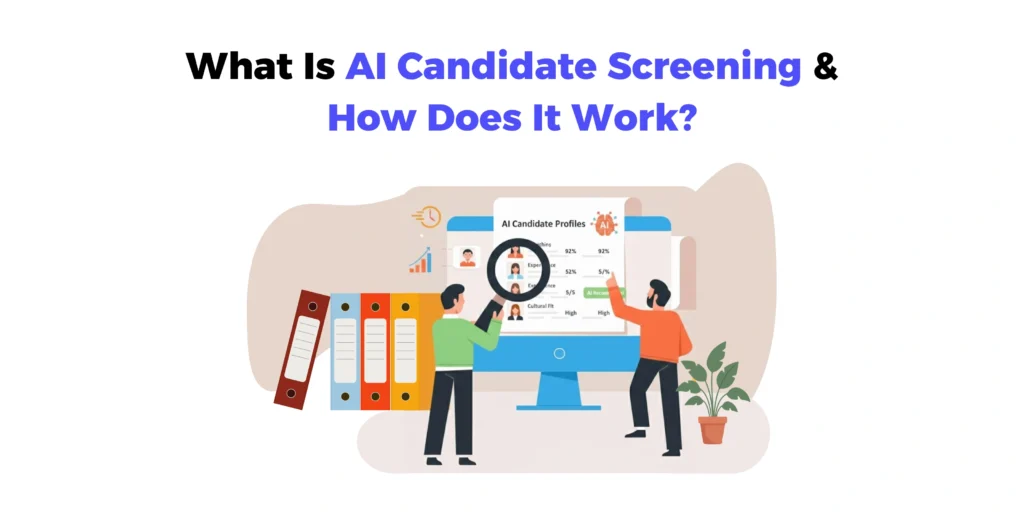
AI candidate screening involves tools that process resumes, assess skills, and even conduct initial interactions, moving beyond simple keyword matches to evaluate qualifications holistically.
In 2025, 87% of companies will use some form of AI in recruitment, up from 48% the previous year, driven by the need for speed in competitive markets. The global AI recruitment market, valued at USD 596.16 million this year, is projected to reach USD 860.96 million by 2030, growing at a 7.63% CAGR.
This guide examines automated candidate screening and AI candidate screening in detail, including their mechanics, applications, advantages, drawbacks, ethical aspects, and projections through 2030.
Readers will learn how these technologies operate, supported by industry data and examples, to inform decisions in talent acquisition.
What Is Automated Candidate Screening?
Automated candidate screening refers to software systems that systematically evaluate job applications without full human involvement, typically starting with applicant tracking systems (ATS) that parse resumes and match them to job requirements.
Traditional automated candidate screening relies on rule-based filters, such as keyword searches for terms like “Python” in a software engineer role, to sort candidates into categories like “qualified” or “review later.”
This approach evolved from basic ATS in the 1990s, which digitized resume storage, to more advanced systems in the 2010s incorporating basic automation. By 2025, 99% of Fortune 500 companies use ATS, with 75% integrating tech-driven assessments.
However, early automated candidate screening often missed nuances, like equating “managed team” with leadership without context.
AI candidate screening builds on this by incorporating machine learning models that learn from data patterns. For instance, natural language processing (NLP) extracts skills from unstructured text, while predictive algorithms score candidates based on historical hire success.
Unlike rigid automation, AI candidate screening adapts over time, achieving 89-94% accuracy in matching, often surpassing human rates. In practice, 88% of companies now apply AI for initial resume reviews, handling the 80% of data that remains unstructured in applications.
The distinction matters: automated candidate screening excels in high-volume, low-complexity roles, while AI candidate screening shines in nuanced evaluations, reducing time-to-shortlist by up to 40%. Both reduce administrative load, but AI introduces data-driven insights, making it essential for modern hiring.
How AI Candidate Screening Works? Step-by-Step Process
AI candidate screening operates through a sequence of interconnected processes, powered by algorithms that ingest, analyze, and output candidate evaluations.
Below is a breakdown of the key steps, illustrated with technical details and real-world parallels.
#1 Resume Parsing & Structured Data Extraction
The process begins with resume parsing, where AI tools like NLP models scan documents in various formats (PDF, Word) to extract elements such as education, experience, and skills.
Tools like Sovren or Daxtra, integrated into many ATS, use optical character recognition (OCR) for scanned files and entity recognition to identify specifics, e.g., “3 years in SQL” as a quantifiable skill.
This step converts unstructured text into structured data, populating fields in a database. Accuracy reaches 95% for standard resumes, but challenges arise with non-standard formats, where error rates can hit 10-15%. Output: A candidate profile with tagged attributes, ready for matching.
#2 Semantic Matching & Contextual Understanding
Next, semantic matching compares the parsed data against job descriptions using vector embeddings, numerical representations of text meaning. Models like BERT assess similarity beyond keywords; for example, recognizing “data analysis” as relevant to “business intelligence” roles.
In 2025, 82% of AI screening tools employ this for contextual fit, improving match rates by 30% over keyword-only methods. Tools flag gaps, like missing certifications, while inferring equivalents from experience.
#3 Skills Inference & Gap Analysis
AI infers unlisted skills via pattern recognition, for instance, GitHub activity suggesting coding proficiency. Gap analysis then scores deficiencies against role needs, using weighted algorithms (e.g., 40% technical skills, 30% soft skills).
This reduces oversight of transferable talents, with studies showing 20% more diverse shortlists. Predictive models forecast performance, drawing from hire data.
#4 Bias Detection & Fairness Algorithms
To counter biases, integrated fairness checks anonymize profiles (removing names, genders) and apply demographic parity metrics, ensuring equal advancement rates across groups.
Tools audit training data, flagging imbalances like overrepresentation of certain demographics.
By 2025, 67% of systems include these, though 35% of recruiters note persistent risks.
#5 Scoring, Ranking & Shortlisting
Candidates receive composite scores (e.g., 0-100) from weighted factors, ranked via machine learning. Top 10-20% advance automatically, with explanations like “85% fit: Strong in Python, moderate leadership.”
This cuts review time by 71%.
#6 Integration with ATS, Job Boards, and CRM
Finally, results feed into ATS like Workday or CRM systems, triggering actions like email invites. APIs connect to LinkedIn for sourcing, creating closed-loop systems. 65% of tools now integrate seamlessly, boosting end-to-end efficiency.
Top Use Cases & Real-World Applications of AI Candidate Screening
AI candidate screening applies across scenarios, with 56% of recruiters citing it as the top benefit for initial evaluations.
Here are key use cases, each with examples and outcomes.
- High-Volume Hiring (Retail, Call Centers, Gig Economy): For roles receiving 1,000+ applications, AI automates triage. McDonald’s “Text to Apply” uses Paradox’s Olivia chatbot for screening via SMS, asking qualification questions and scheduling based on availability. This reduced time-to-interview by 50% and handled 1 million+ interactions annually. In gig platforms like Uber, AI scans profiles for driver fit, cutting manual reviews by 75%.
- Tech & Engineering Roles (GitHub + Resume + Coding Test Analysis): AI combines resume data with external sources like GitHub commits. Google’s hiring pipeline uses NLP to evaluate code samples alongside resumes, improving technical match accuracy to 85% and shortening cycles by 25%. Siemens applies AI for ranking, boosting hire quality by 20%.
- Diversity Hiring & Blind Screening: Anonymizing tools remove identifiers to focus on merits. Unilever’s AI system eliminated names and photos, increasing shortlisted diverse candidates by 16% and achieving its most inclusive class. Hilton’s chatbots for initial screening reduced bias, enhancing engagement and diversity hires by 15%.
- Internal Mobility & Talent Redeployment: AI scans internal profiles for redeployment. Mastercard uses Phenom’s platform to match employees to openings, reducing external hires by 30% and retention by improving internal moves. Nestlé’s Olivia screens for promotions, cutting mobility time by 40%.
- Executive & Specialized Search (with Human-in-the-Loop): For senior roles, AI pre-screens but flags for review. Vodafone uses AI to speed sourcing, reducing time-to-hire by 30% while humans validate. L’Oréal’s Mya chatbot handles initial executive queries, improving match rates by 25%.
These cases show AI candidate screening’s adaptability, with 70% of large employers reporting measurable gains.
Benefits of AI-Driven Candidate Screening
AI candidate screening delivers quantifiable gains, with 67% of users noting time savings as primary.
Key advantages include:
- Time Savings: Reduces screening by 67-75%, from hours to seconds per resume, enabling 41% higher recruiting efficiency. Overall time-to-hire drops 25%, from 27 to 7 days in some cases.
- Cost-Per-Hire Reduction: Lowers expenses by 30-45%, with screening costs down 75% via automation. One study found 87.64% financial savings in conversational AI scenarios.
- Quality of Hire Improvement: Boosts retention by 20-35%, with AI-selected candidates showing 14% higher interview success. Predictive matching yields 53% success in human follow-ups vs. 29% traditional.
- Candidate Experience: Provides instant feedback, with 67% comfortable if humans decide finals. Chatbots like Olivia improve satisfaction by 20%.
- Scalability for Seasonal or Rapid-Growth Hiring: Handles surges without added staff, as in retail where it processes thousands daily.
These benefits position AI candidate screening as a core tool, with 63% of recruiters expecting it to replace manual screening soon.
Challenges, Risks & Ethical Considerations
Despite gains, AI candidate screening poses hurdles, with 66% of candidates avoiding AI-screened jobs due to fairness fears.
Key issues:
- Algorithmic Bias: Systems trained on historical data can perpetuate disparities, affecting 20-30% of outputs in diverse groups; Amazon’s tool once favored male candidates. 67% of companies acknowledge this risk.
- Black-Box Decision Making: Opaque algorithms hinder explanations, violating transparency norms; only 8% of seekers trust them for fairness.
- Over-Reliance on Past Data: Ignores unique talents, with 35% of recruiters fearing overlooked potential.
- GDPR, EEOC, and State-Law Compliance: Laws like NYC’s Local Law 144 require bias audits; non-compliance risks fines, as in Workday lawsuits. 65% use AI for rejections, raising EEOC scrutiny.
- Candidate Perception & Trust: 74% of managers fear fraud from AI tricks, eroding confidence.
Mitigation includes diverse datasets, regular audits, explainable AI, and human oversight, strategies adopted by 70% of ethical implementations.
Conclusion
Automated candidate screening and AI candidate screening mark a shift from labor-intensive reviews to data-informed processes, processing vast applications with precision.
From parsing resumes to predicting fits, these tools cut times and costs while raising vital questions on equity. Balancing automation with oversight ensures benefits like 30% lower costs and improved hires outweigh risks.
ContactSwing provides AI voice agents that support automated candidate screening by conducting preliminary phone or voice interactions.
These agents ask targeted questions to gauge qualifications and communication abilities, then feed structured responses into ATS systems.
This approach helps recruiters prioritize top candidates while ensuring compliance with privacy standards, allowing for more focused human evaluations in the hiring pipeline.
By 2030, widespread integration promises efficient, fairer hiring, provided ethical practices guide adoption. Recruiters should audit tools regularly, blending AI insights with human judgment for optimal results.
FAQs
What is AI candidate screening?
AI candidate screening uses machine learning and NLP to evaluate resumes, skills, and fit against job criteria, automating initial reviews. It processes unstructured data for contextual matches, achieving 89-94% accuracy and reducing screening time by 71%, as seen in tools like Workday. (42 words)
How accurate is automated candidate screening?
Automated candidate screening reaches 89-94% accuracy in matching, often exceeding human levels by analyzing patterns beyond keywords. However, it depends on data quality; biases can lower rates to 70-80% without audits, per studies on tools like HireVue. (41 words)
Does AI screening discriminate against candidates?
AI screening can amplify biases from training data, impacting 20-30% of diverse applicants, as in Amazon’s case favoring certain genders. Mitigation via anonymization and audits reduces risks, with 67% of systems now including fairness checks for equitable outcomes. (43 words)
Can AI replace human recruiters?
AI handles 40% of repetitive tasks like screening by 2025 but cannot fully replace humans, who provide nuanced judgment. 31% of leaders expect partial shifts by 2030, with AI augmenting strategy and final decisions for better retention. (40 words)
How long does AI candidate screening take?
AI candidate screening processes resumes in seconds, reducing full reviews from hours to minutes per batch. High-volume tools like Paradox’s Olivia handle thousands daily, cutting time-to-shortlist by 40% compared to manual methods. (39 words)
Which companies use AI for candidate screening?
Unilever uses AI for bias-free shortlisting, boosting diversity by 16%; Hilton employs chatbots to manage volumes, reducing wait times by 50%; Google’s pipeline analyzes code for tech roles, improving accuracy by 25%. (42 words)
Is AI candidate screening legal?
AI candidate screening complies with laws like EEOC and GDPR if audited for bias and transparent. 65% of firms auto-reject via AI, but violations like NYC Law 144 can lead to fines; human oversight ensures adherence. (41 words)
How does AI parse and understand resumes?
AI parses resumes via NLP and OCR, extracting entities like skills and dates into structured data. Semantic models like BERT infer context, achieving 95% accuracy on standard formats, as in Sovren-integrated ATS. (38 words)
What’s the difference between ATS and AI screening?
ATS focuses on storage and basic keyword automated candidate screening, while AI screening adds machine learning for semantic analysis and predictions. AI improves match rates by 30%, handling 80% unstructured data vs. ATS’s 60%. (40 words)
What are future trends in AI candidate screening?
By 2030, multimodal AI will integrate video/voice, with 94% adoption and 90% automation for routine roles. Predictive models and agentic systems will forecast needs, growing the market to USD 1.56 billion at 7.4% CAGR.