


In an era where healthcare systems are inundated with vast amounts of data, much of it unstructured, such as clinical notes, patient feedback, and medical literature, natural language processing (NLP) emerges as a transformative technology. NLP, a branch of artificial intelligence, enables computers to understand, interpret, and generate human language in a way that is both meaningful and actionable.
In healthcare, this means extracting valuable insights from textual and spoken data that would otherwise remain buried in electronic health records (EHRs) or conversation transcripts.
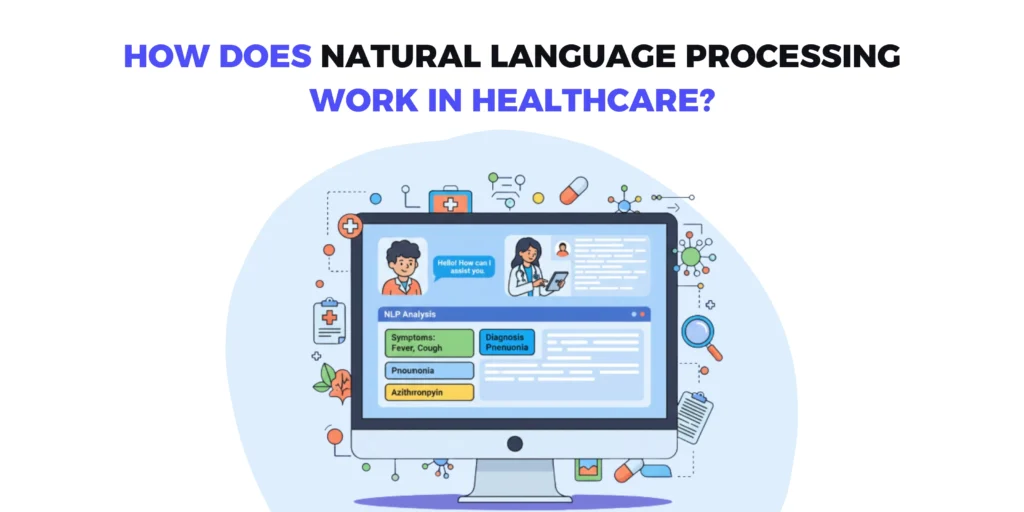
What is natural language processing in healthcare? At its core, it involves algorithms that process unstructured data, like physician dictations or patient emails, to identify patterns, sentiments, and key information. For instance, NLP can convert a doctor’s narrative note into structured data for easier analysis, helping to flag potential diagnoses or treatment gaps.
According to industry reports, the global NLP in healthcare and life sciences market is valued at approximately USD 7.76 billion in 2025 and is projected to reach USD 58.83 billion by 2034, growing at a compound annual growth rate (CAGR) of over 25%. This rapid expansion underscores NLP’s role in addressing key challenges, such as administrative burdens that consume up to 30% of physicians’ time and contribute to burnout.
This blog will explore the fundamentals of NLP in healthcare, its diverse applications, benefits and challenges, and future trends. By delving into these aspects, readers will gain a comprehensive understanding of how NLP is not just a tool but a catalyst for more efficient, patient-centered care.
Whether you’re a healthcare professional, researcher, or tech enthusiast, the insights here highlight NLP’s potential to bridge the gap between raw data and informed decision-making.
What is NLP in Healthcare?
Natural language processing in healthcare refers to the application of computational techniques to analyze and derive meaning from human language data specific to medical contexts.
Unlike general NLP used in search engines or virtual assistants, healthcare NLP must handle specialized vocabulary, such as anatomical terms, drug names, and diagnostic codes, while adhering to strict regulatory standards like the Health Insurance Portability and Accountability Act (HIPAA) in the United States.
To understand what is NLP in healthcare, it’s essential to break down its core components.
NLP systems typically involve several stages: tokenization, where text is divided into words or phrases; part-of-speech tagging, which identifies grammatical roles; named entity recognition (NER), which spots entities like symptoms or medications; and sentiment analysis, which gauges emotional tones in patient reviews.
These processes are powered by machine learning models, including deep learning architectures like transformers, which have revolutionized accuracy since the advent of models like BERT in 2018.
Historically, NLP’s roots trace back to the 1950s with early machine translation efforts, but its healthcare adoption accelerated in the 2010s with the digitization of EHRs. Today, in 2025, over 80% of healthcare data remains unstructured, making NLP indispensable for maximizing its value. For example, NLP tools can process millions of clinical notes to identify trends in disease outbreaks or treatment efficacy, far surpassing manual review capabilities.
Key technologies behind NLP include rule-based systems for simple pattern matching and advanced AI models like large language models (LLMs) such as GPT-4, which are increasingly customized for medical use.
Open-source LLMs are gaining traction, with studies showing they achieve up to 95% accuracy in extracting clinical entities when fine-tuned on domain-specific data. Why does NLP matter in healthcare today? With global healthcare spending projected to exceed USD 10 trillion by 2025, inefficiencies in data management cost billions annually.
NLP addresses this by automating tasks like coding and summarization, reducing errors that affect 1 in 10 diagnoses due to miscommunication. In essence, NLP transforms raw language into structured intelligence, enabling proactive care and research advancements.
NLP Applications in Healthcare
NLP applications in healthcare span a wide array of functions, from automating administrative tasks to enhancing clinical insights.
These tools process unstructured data, estimated to comprise 80% of all health information, to support decision-making and improve outcomes. Below, we explore key applications with real-world examples.
- Clinical Documentation and EHR Management
One of the most prominent NLP applications in healthcare is computer-assisted coding (CAC), where NLP algorithms extract billable codes from physician notes, reducing manual effort by up to 50% and improving accuracy.
For instance, systems like those used by the Mayo Clinic employ NLP to parse EHRs, identifying key elements such as symptoms and procedures to populate structured fields automatically. This not only speeds up documentation, cutting time from hours to minutes, but also minimizes coding errors that lead to claim denials, which affect 10-15% of U.S. healthcare reimbursements annually.
Another example is ambient clinical intelligence, where NLP transcribes and summarizes doctor-patient conversations in real-time. Companies like Nuance have implemented this in hospitals, resulting in a 20-30% reduction in physician burnout by alleviating note-taking burdens.
- Patient Engagement and Communication
NLP enhances patient interactions through chatbots and virtual assistants that handle queries, schedule appointments, and provide health advice.
For example, the Cleveland Clinic uses NLP-powered chatbots to triage symptoms, directing patients to appropriate care and reducing unnecessary ER visits by 15-20%. In telemedicine, NLP analyzes voice tones and text from virtual consultations to detect sentiment, flagging potential mental health issues early.
Real-world adoption includes apps like Ada Health, which uses NLP to interpret user-described symptoms against vast medical databases, achieving diagnostic accuracy rates of over 70% in initial assessments.
- Predictive Analytics and Research
NLP drives predictive modeling by mining medical literature and patient records for insights. In drug discovery, tools like IBM Watson Health apply NLP to analyze millions of research papers, accelerating identification of drug candidates and shortening development timelines by 25-30%.
For population health, NLP identifies at-risk cohorts; for instance, during the COVID-19 pandemic, NLP systems processed social media and EHR data to predict outbreak hotspots with 85% accuracy.
Sentiment analysis of patient feedback helps hospitals improve services, with studies showing a 10-15% boost in satisfaction scores after implementing NLP-driven adjustments.
- Fraud Detection and Compliance
NLP scans insurance claims and records for anomalies, detecting fraudulent patterns that cost the U.S. healthcare system over USD 100 billion yearly.
Systems like those from Optum use NLP to flag inconsistencies, recovering up to 5% of lost revenue. For compliance, NLP ensures documentation meets regulatory standards, automating audits and reducing violation risks.
- Other Emerging Uses
In personalized medicine, NLP integrates genomic data with clinical notes to tailor treatments, as seen in oncology where it predicts therapy responses with 80% precision.
Mental health monitoring via text analysis of therapy sessions or apps identifies depression indicators early, potentially preventing 20% of severe cases through timely interventions.
These applications demonstrate NLP’s versatility, with adoption rates climbing to 60% among large U.S. hospitals in 2025.
Benefits and Challenges of Natural Language Processing in Healthcare
NLP offers substantial benefits in healthcare, but it also presents notable challenges. Understanding both is crucial for effective implementation.
Benefits
- Enhanced Efficiency and Accuracy: NLP automates data extraction, reducing administrative time by 30-50% and minimizing human errors in coding and diagnostics.
- Improved Patient Outcomes: By enabling predictive analytics, NLP supports early interventions, potentially lowering readmission rates by 15-20%.
- Cost Savings: Fraud detection and optimized resource allocation can save billions; for example, NLP-driven claims processing reduces denials by 10-15%.
- Scalability and Insights: Analyzing vast datasets uncovers trends, accelerating research and improving population health management.
Challenges
- Data Privacy and Security: Handling sensitive information requires HIPAA compliance, but risks of breaches persist, with 90% of healthcare organizations reporting cyber incidents in 2024.
- Accuracy and Bias: Models may struggle with medical jargon, dialects, or underrepresented data, leading to biases that affect 20-30% of AI outputs in diverse populations.
- Integration Hurdles: Merging NLP with legacy EHR systems is complex, costing up to 25% more in implementation.
- Ethical Concerns: Issues like algorithmic transparency and consent for data use raise questions, necessitating robust governance frameworks.
Solutions include using federated learning for privacy-preserving models and regular audits to mitigate biases, ensuring NLP’s benefits outweigh its risks.
The Future of Natural Language Processing Healthcare
Looking ahead, NLP in healthcare is poised for exponential growth, driven by advancements in multimodal AI that combine text, voice, and images for holistic analysis.
Trends include the rise of domain-specific LLMs, with over 70% of new models in 2025 tailored for sectors like oncology and mental health. Integration with wearables and IoT devices will enable real-time monitoring, predicting health events with 90% accuracy in pilot studies.
By 2030, NLP adoption could reach 90% in developed healthcare systems, fueled by a market growth to USD 24 billion. Challenges like ethical AI use will be addressed through global standards, paving the way for more equitable, efficient care.
ContactSwing.ai uses NLP to develop AI voice agents that streamline patient interactions in healthcare settings.
By enabling no-code deployment of HIPAA-compliant assistants for tasks like appointment scheduling, symptom triage, and after-hours support, ContactSwing helps reduce administrative burdens and improve response times, ultimately enhancing patient satisfaction and operational efficiency without requiring extensive technical expertise.
Conclusion
In summary, natural language processing in healthcare represents a pivotal shift toward data-driven, efficient care.
From defining what is NLP in healthcare to exploring its applications, like clinical documentation and predictive analytics, this technology unlocks unstructured data’s potential, offering benefits such as cost savings and better outcomes while navigating challenges like privacy.
As trends evolve, NLP will continue to innovate, ensuring healthcare becomes more accessible and precise for all.
FAQs on NLP Healthcare
What is natural language processing in healthcare?
Natural language processing (NLP) in healthcare is an AI technology that analyzes unstructured data like clinical notes and patient conversations to extract meaningful insights. It handles medical jargon and integrates with EHRs, improving accuracy in tasks such as coding and diagnostics, with market adoption growing at 17.5% CAGR through 2035.
How does NLP improve clinical documentation?
NLP automates the extraction of key information from physician notes, converting it into structured formats for EHRs. This reduces documentation time by 30-50%, minimizes errors, and combats physician burnout, as seen in systems like those at Mayo Clinic that enhance coding efficiency and compliance.
What are the main benefits of NLP in healthcare?
Key benefits include enhanced efficiency, better patient outcomes through predictive analytics, cost savings via fraud detection, and scalable research insights. For instance, NLP can lower readmission rates by 15-20% and save billions in administrative costs by processing unstructured data effectively.
What challenges does NLP face in healthcare?
Challenges encompass data privacy under HIPAA, accuracy issues with biases or jargon, integration with legacy systems, and ethical concerns like transparency. Biases can impact 20-30% of outputs, but solutions like federated learning and audits help mitigate these risks for reliable deployment.
Can NLP be used for patient engagement?
Yes, NLP powers chatbots and virtual assistants for symptom triage, appointment scheduling, and sentiment analysis in feedback. Real-world examples like Cleveland Clinic’s tools reduce ER visits by 15-20%, improving accessibility and satisfaction through natural, conversational interactions.
What is the future outlook for NLP in healthcare?
By 2030, NLP could achieve 90% adoption, with multimodal AI and domain-specific models driving innovations in personalized medicine and real-time monitoring. Market growth to USD 58.83 billion by 2034 highlights its role in equitable, efficient care advancements.
How does NLP aid in fraud detection in healthcare?
NLP analyzes claims and records for anomalies, identifying fraudulent patterns that cost over USD 100 billion annually. Tools recover up to 5% of lost revenue by flagging inconsistencies, ensuring compliance and protecting resources in insurance and billing processes.