


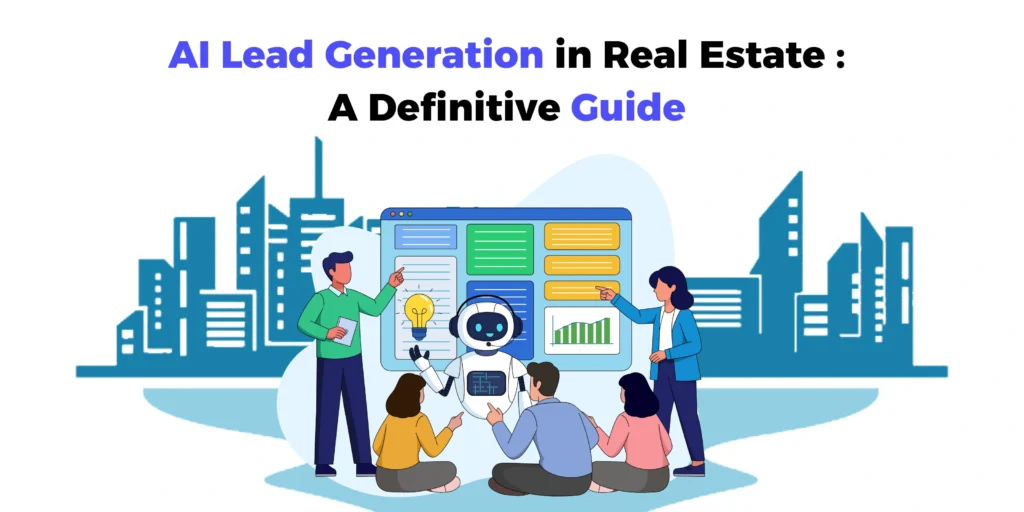
Most real estate agents have the same problem: not a total lack of leads, but a lack of time to chase every inquiry and figure out who is serious. Traditional funnels generate quantity, but not always quality, and even good leads die if they wait too long for a response. AI real estate lead generation flips that model by doing the heavy lifting on targeting, qualification, and follow‑up, so you spend more time talking to the right people at the right moment.
Industry reports back this shift. Analysts estimate the global AI in real estate market will reach close to 1 trillion USD before the end of the decade, with lead generation and marketing among the top use cases driving that growth. For agents, this is not a theoretical future; it is a competitive edge that is already available in off‑the‑shelf tools.
What Is AI Lead Generation?
AI lead generation means using artificial intelligence to find, attract, and qualify potential buyers and sellers based on data rather than guesswork. In real estate, that data includes online behavior, search patterns, property interests, demographics, and responses to your marketing.
Instead of manually:
- Guessing who might be ready to move.
- Calling every portal lead with the same script.
- Sending generic follow‑up emails to everyone.
AI lead generation for real estate tools can:
- Analyze who is looking at what, where, and how often.
- Score and prioritize leads based on their likelihood to transact.
- Send personalized messages and content automatically, then adapt based on engagement.
You still decide your market, positioning, and offers. AI just helps you spend your effort where it is most likely to pay off.
Current Lead Generation Methods in Real Estate
Before diving into AI-led generation of real estate workflows, it helps to see where most agents are starting from.
Common “pre‑AI” methods include:
- Portal and listing site leads: Inquiries from big portals and property sites. High volume, mixed intent, intense competition.
- Paid social and search ads: Facebook, Instagram, and Google Ads driving traffic to landing pages or lead forms.
- Open houses and events: Sign‑in sheets, business cards, and manual follow‑up.
- Referrals and past clients: Still one of the strongest sources of quality leads, but often under‑nurtured.
- Cold outreach: Expired listings, FSBOs, absentee owners, and investor lists.
These channels work, but they share a few problems:
- Lead quality is uneven.
- Response times are often slow.
- Follow‑up is inconsistent and heavily dependent on your energy and memory.
AI does not replace these channels; it makes them smarter and more efficient.
AI Lead Generation in Real Estate
AI real estate lead generation tools sit on top of your existing channels and data. They help you:
- Target better.
- Respond faster.
- Nurture more consistently.
- Close more of what you already generate.
Here are the main ways this shows up.
1. Predictive Lead Scoring
Predictive lead scoring uses machine learning to give each lead a “conversion likelihood” score based on their profile and behavior. The model looks at:
- Where the lead came from (source and campaign).
- How they behave (pages viewed, listings clicked, emails opened, replies sent).
- What similar past leads who actually bought or sold looked like.
Tools like Leadflow analyze dozens of signals (equity, absentee ownership, tax status, pre‑foreclosure indicators) to rank seller leads by motivation and urgency, so agents can target those most likely to move. Platforms like SuperAGI report that predictive analytics can increase lead conversion by up to 25% and shorten sales cycles by around 30% when agents prioritize outreach based on these scores.
For a working agent, this means:
- You call “A‑grade” leads first.
- You put lower‑scoring leads into slower, automated nurture sequences.
- You stop wasting time treating every inquiry the same.
2. Smarter Targeting And Ad Optimization
AI lead generation real estate platforms increasingly handle the “who sees which ad” problem.
They can:
- Build lookalike audiences based on past converters.
- Automatically test and rotate creatives, copy, and audiences.
- Shift budget toward campaigns that produce real inquiries, not just clicks.
Many AI‑driven ad platforms for real estate plug into your MLS, automatically pull the best photos and details from your listings, and generate high‑converting video or carousel ads for Meta and other platforms. The system then learns which combinations of listing type, wording, and audience give you the best cost per lead.
You still set the strategy (budget, geography, price range), but AI does the day‑to‑day optimization.
3. Chatbots And AI Assistants That Capture And Qualify Leads
AI chatbots and virtual ISAs (inside sales agents) can:
- Greet visitors on your website or landing pages 24/7.
- Ask qualifying questions (budget, timeline, location).
- Share property info, virtual tours, and documents.
- Book appointments directly into your calendar.
Tools like Ylopo’s Raiya or similar AI assistants handle initial conversations by text or voice, gather key data, and only bring you in when a lead is warmed up. This closes the gap between inquiry and reply, which is critical: speed‑to‑lead studies show that contacting a lead within five minutes can make them around 21 times more likely to convert compared with waiting 30 minutes or longer.
Instead of missing messages that arrive at 11 pm, you wake up to a list of qualified leads who have already answered the basics.
4. AI For Content And Nurture
AI also helps with the content side of AI lead generation for real estate:
- Drafting newsletter content tailored to buyers vs sellers.
- Generating personalized listing emails based on previous clicks.
- Creating variations of follow‑up messages for different segments.
While you still need to review and adjust for tone, this dramatically reduces the friction of staying in regular contact. AI content plus behavioral triggers gives you nurture at scale that still feels specific.
How to Get Started with AI Lead Generation for Real Estate
You do not need to rebuild your business overnight. Here is a practical way to ease into AI lead generation real estate workflows.
Step 1: Audit Your Current Funnel
Write down:
- Where your leads come from now (portals, ads, referrals, website, social).
- How you respond (timeframe, channel, message).
- How you decide who to call and when.
- Where leads go to die (e.g., old spreadsheets, email inboxes).
This gives you a baseline and shows where AI can help first.
Step 2: Choose 1–2 AI‑Enabled Tools
Look for tools that:
- Integrate with your CRM or website.
- Offer AI lead scoring or qualification.
- Include chatbots or automated follow‑up sequences.
Common categories:
- AI‑first lead platforms (e.g., Ylopo, Leadflow, Marquiz, etc.).
- CRMs with built‑in AI scoring and automation.
- AI chat/voice assistants that sit on top of your existing forms and portals.
Start with something that solves your biggest problem (slow follow‑up, too many low‑quality leads, or cold leads sitting untouched).
Step 3: Set Up Speed‑To‑Lead Automation
Whatever tool you pick, nail speed first.
- Configure instant acknowledgment messages for every new inquiry (email or SMS).
- Route new leads to a chatbot or AI assistant that can ask a few key questions.
- Set alerts so you know when a lead reaches a certain score and needs a personal call.
Speed‑to‑lead research shows big gains: one widely cited metric notes that leads contacted within five minutes convert dramatically better than those contacted after 30 minutes, and many companies see double‑digit increases in sales after tightening response times with automation.
Step 4: Layer On Predictive Scoring And Segmentation
As data builds up, you can:
- Turn on predictive scoring (if your tool supports it).
- Tag leads by source, behavior, and interest (buyers vs sellers, investors vs homeowners).
- Create different sequences for high‑score vs low‑score leads, and for each segment.
For example:
- High‑score portal buyer leads → immediate call + tight follow‑up.
- Lower‑score website leads → educational email series + monthly check‑ins.
- Investor leads → deal alerts and market data, not generic home‑buyer tips.
Step 5: Review, Tweak, And Double‑Down
Set time every month to:
- Check which AI‑driven campaigns and sequences are generating appointments.
- Look at how predictive scores line up with actual deals.
- Adjust your scripts, ad creative, and segmentation where needed.
AI is not “set and forget.” It improves fastest when you give it feedback, prune what does not work, and invest more in what does.
A good way to get started is to explore ContactSwing for real estate. Using AI voice calling, trigger-based emails and SMS, and even WhatsApp follow-ups, real estate agents can scale up AI lead generation.
Common Pitfalls to Avoid
AI lead generation real estate strategies are powerful, but there are a few traps that can hurt results and brand.
1. Treating AI As Magic, Not A Tool
AI is great at pattern‑finding and automation, but it does not know your market the way you do. If you let it run completely unsupervised, you can:
- Over‑optimize for cheap leads instead of quality ones.
- Serve ads or messages that do not fit your brand or compliance rules.
- Miss important nuances in your local market.
Keep humans in the loop, especially for strategy and high‑stakes decisions.
2. Over‑Automating The Human Moments
AI should not handle:
- Price discussions and negotiation strategy.
- Delivering bad news or navigating emotional situations.
- Complex, multi‑party coordination (without your oversight).
Use AI to open conversations, not to replace the ones where human empathy and judgment matter most.
3. Ignoring Data Quality
If your CRM is full of duplicates, outdated info, and vague tags, even the best AI models will struggle. Clean up:
- Basic fields (name, contact, role).
- Source tracking.
- Segmentation (buyer/seller, hot/warm/cold).
Better data in means better predictions and personalization out.
4. Forgetting Compliance And Consent
When running AI‑driven outreach:
- Make sure you have proper opt‑in for email and SMS.
- Respect unsubscribe and do‑not‑contact requests.
- Keep an eye on local regulations around automated calling and messaging.
Short‑term gains from aggressive automation are not worth long‑term reputational or legal risk.
Conclusion
AI lead generation real estate strategies are not about replacing agents with robots. They are about letting machines do what they are good at analyzing data, responding instantly, and running repeatable processes- so agents can double down on what humans are best at: trust, strategy, and negotiation.
The market is moving fast. Surveys suggest that over three‑quarters of real estate professionals expect AI to significantly impact their business within the next few years, and early adopters are already reporting higher conversion rates and shorter sales cycles. The question is less “Will AI change lead generation?” and more “Will you be one of the agents using it, or one of the ones competing against those who do?”
Pick one starting point-chatbots, predictive lead scoring, or AI‑optimized ads-and commit to testing it on your next batch of leads. Let the results guide your next move.
FAQs
Q1. What is AI lead generation for real estate, in simple words?
AI lead generation for real estate means using software that learns from data (like online behavior, property searches, and past deals) to find, rank, and follow up with the people most likely to buy or sell, instead of treating every lead the same.
Q2. Do I need to be “good with tech” to use AI lead gen tools?
Not really. Most modern platforms come with templates, visual dashboards, and plug‑and‑play integrations. You mainly need to understand your funnel and be willing to test and tweak.
Q3. Will AI replace human real estate agents?
No. AI is strong at pattern recognition and automation but weak at local market nuance, negotiation, and human emotion. The agents who win will be those who combine AI real estate lead generation tools with strong personal service.
Q4. Which AI lead generation tool should I start with?
Start with the problem that hurts most. If you get lots of leads but respond slowly, try an AI chatbot or voice assistant. If you get many low‑quality leads, look at predictive lead scoring. If you struggle to create content, use AI for ads and email drafts.
Q5. How quickly can I expect results from AI lead generation real estate tools?
Some benefits show up fast-like more conversations from faster replies-while predictive scoring and optimization get better over a few weeks to months as the system learns from your data.Q6. Is AI lead gen only for big teams and brokerages?
No. Many AI lead generation real estate platforms are priced for solo agents and small teams, and can plug into existing CRMs and websites without custom development.