


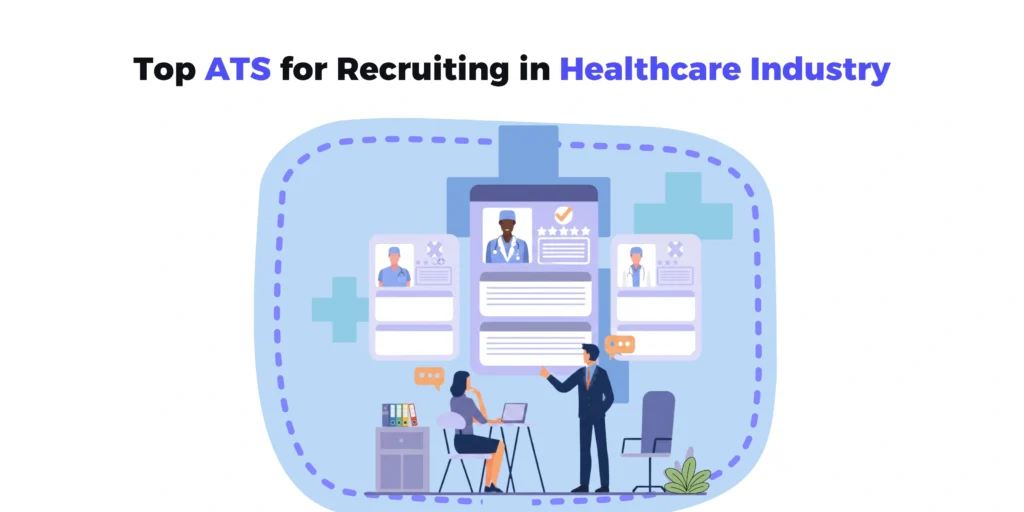
Healthcare applicant tracking systems (ATS) matter more than “normal” ATS tools because healthcare hiring is credential-heavy, compliance-heavy, and usually time-sensitive (because understaffing hits patient care). An ATS that works for tech hiring can feel painfully incomplete for healthcare recruiting, especially for staffing agencies managing travel nurses, per diem pools, and license expirations. Hence, hiring is one of the biggest challenges that the healthcare industry faces on a daily basis, and it is only just starting to be solved via AI technology.
Below is a listicle-style guide to the top 8 ATS systems for recruiting in healthcare, featuring a clear flow, practical selection criteria, and concise “best for” positioning.
What makes a good healthcare ATS
Before the list, here’s the filter that actually matters in healthcare applicant tracking systems:
- Credential + compliance workflows: license tracking, document collection, expiration reminders, and audit readiness.
- High-volume pipeline handling: lots of applicants, fast screening, quick outreach.
- Recruiter productivity features: automation, matching, and communication tools.
- Integration depth: ability to connect with HR systems, payroll, background checks, and job boards.
- Candidate experience: mobile-friendly applications, self-scheduling, and fast communication.
If an ATS fails on credentialing + speed, it will slow down placement and burn out recruiters, no matter how pretty the UI looks.
Top 8 Applicant Tracking Systems for Healthcare Staffing
Ready to dive into the list of the different ATS that can solve your healthcare staffing problems? Here is the full list:
1) CEIPAL Healthcare (Best for healthcare staffing agencies)
CEIPAL Healthcare positions itself as an ATS built for healthcare staffing and recruiting, with emphasis on sourcing, engagement, compliance tracking, and an ATS + VMS (vendor management system) approach for contingent workforce workflows. It also highlights automation for credential verification and tracking document expiration dates, which is a core pain point in healthcare recruiting.
Why it stands out
- Built-in credentialing and license/document workflows (including expiration tracking).
- Candidate portal for uploading certifications and required documents.
- Job posting distribution and automation features to reduce manual recruiter work.
Best for
- Staffing firms placing travel, per diem, locum, and allied health at scale.
2) Bullhorn (Best for agency-style recruiting + staffing operations)
Bullhorn is widely used in staffing and recruiting, and it’s often referenced specifically for healthcare staffing agencies that need to fill high-volume roles quickly and manage large candidate pools. Bullhorn also publishes an ATS buyer’s guide focused on staffing workflows, reinforcing its positioning in the staffing world.
Why it stands out
- Strong fit for staffing agency workflows and fast-moving pipelines.
- Recognized market presence and staffing focus (useful when teams want a mature ecosystem).
Best for
- Healthcare recruiting firms and staffing agencies that run high-volume placements.
3) iCIMS (Best for enterprise healthcare systems)
iCIMS describes itself as an enterprise-grade ATS and recruiting platform, emphasizing AI and automation for screening, matching, scheduling, and candidate communication. It also highlights broad integration support (800+ partner technologies and thousands of integrations) and security/compliance controls like encryption and audit trails.
Why it stands out
- Enterprise hiring at scale (bulk candidate management and automated communication).
- Large integration ecosystem with HR/payroll systems and other recruiting tools.
- Strong security and compliance posture as part of platform messaging.
Best for
- Hospitals, large health systems, and multi-site healthcare groups hiring across many roles.
4) SmartRecruiters (Best for modern UX + integration marketplace)
SmartRecruiters is often positioned as a modern ATS with marketplace integrations and a streamlined candidate experience, including mobile-friendly workflows. It’s commonly included in “top healthcare ATS” roundups for teams that want a modern recruiting interface.
Why it stands out
- Modern user experience and recruiting workflows for distributed teams.
- Large integrations marketplace approach (useful when building a modular recruiting stack).
Best for
- Mid-sized healthcare organizations that want an ATS that feels modern and extensible.
5) Lever (Best for ATS + CRM-style nurturing)
Lever is frequently positioned as a combined ATS + candidate relationship management (CRM) style platform, which matters in healthcare because talent pools need long-term nurturing (especially for hard-to-fill specialties).
Why it stands out
- Strong relationship management approach (useful for evergreen pipelines).
- Collaborative recruiting workflows for teams that share candidate ownership.
Best for
- Healthcare organizations that hire continuously and want to nurture pipelines, not just process applicants.
6) MokaHR (Best for healthcare-focused recruiting workflows)
MokaHR is listed in healthcare recruitment software roundups as a tool that helps with healthcare hiring and compliance-oriented workflows, and it’s described as one of the applicant tracking systems for healthcare in 2025 in that context.
Why it stands out
- Positioned specifically around healthcare recruiting needs and structured hiring.
- Emphasis on faster handling of applications and role-based hiring workflows.
Best for
- Healthcare teams that want a healthcare-oriented ATS rather than a generic platform.
7) Talent Pathway (Best for healthcare-specific ATS positioning)
Talent Pathway is presented as a healthcare-focused ATS in healthcare ATS lists, emphasizing recruiting stages from screening to credential verification and compliance tracking. This “healthcare first” framing is useful for teams that want a purpose-built option instead of adapting a generic ATS.
Why it stands out
- Healthcare-specific positioning and compliance-oriented feature emphasis.
- Framed for healthcare facilities and healthcare hiring complexity.
Best for
- Healthcare organizations that want a specialized ATS narrative and compliance-forward process.
8) Connecteam (Best for small teams needing staffing + operations)
Connecteam is more broadly positioned as a workforce management platform, but its healthcare staffing software roundup highlights ATS capability as a key feature for streamlining recruitment and credential/compliance management. It’s often considered when smaller healthcare operators want recruiting plus day-to-day workforce operations in one place.
Why it stands out
- “All-in-one operations” angle: recruiting + workforce management needs.
- ATS is included as part of a broader operational platform.
Best for
- Clinics, home care providers, and smaller healthcare teams that want staffing operations and recruiting together.
Side-by-side: choosing the right ATS
| If your main goal is… | Best fit ATS |
| Healthcare staffing agency workflows + credential/document handling | CEIPAL Healthcare |
| High-volume staffing placements with agency-style pipelines | Bullhorn |
| Enterprise hiring + deep integrations + compliance posture | iCIMS |
| Modern recruiting UX with marketplace integrations | SmartRecruiters |
| Long-term candidate nurturing (ATS + CRM feel) | Lever |
| Healthcare-oriented recruiting workflows (ATS positioning) | MokaHR / Talent Pathway |
| Smaller teams needing recruiting + workforce ops | Connecteam |
Quick FAQs
Are healthcare applicant tracking systems different from normal ATS tools?
Yes-healthcare ATS tools usually need stronger credential/document workflows and compliance tracking because licenses and certifications affect eligibility to work.
What are the top ATS systems for recruitment in staffing agencies?
Tools with staffing-first design are typically better for agency workflows, because they’re built for high-volume pipelines and rapid placement cycles.
Should a healthcare ATS integrate with credentialing and HR/payroll systems?
Yes-ATS value increases when it integrates into the rest of your hiring and onboarding stack, reducing duplicate data entry and speeding up the path from offer to start date.
How do I choose between a healthcare staffing ATS and a hospital ATS?
Staffing agencies need fast sourcing, high-volume pipelines, and credential tracking across many facilities, while hospitals usually prioritize enterprise workflows, internal approvals, and integration with HR systems.
What integrations should an ATS have for healthcare recruiting?
At minimum, a healthcare ATS should integrate with your HR systems and support broad partner integrations so recruiting data flows cleanly from application to hire.
Can an ATS automate license and certification tracking?
Yes-some healthcare-focused systems explicitly support credential and document workflows, including tracking expirations, which is essential for healthcare hiring compliance.
What’s the difference between an ATS and a VMS in healthcare staffing?
An ATS manages candidates and recruiting stages, while a VMS (vendor management system) is typically used to manage contingent labor workflows across clients/facilities-some platforms market both capabilities together.
What ATS features matter most for reducing time-to-hire in healthcare?
Automation for screening, matching, scheduling, and candidate communication tends to reduce delays, especially when paired with strong workflow management and integrations.
Key Takeaways
- Healthcare ATS systems must handle credentialing and compliance alongside speed-to-hire.
- For staffing agencies, CEIPAL Healthcare and Bullhorn are common fits due to staffing-first workflows.
- For enterprise hospitals and multi-site hiring, iCIMS stands out for scale, automation, and integration breadth.
- The “best ATS” depends on whether you recruit like a staffing agency (placements) or like a health system (enterprise talent acquisition).
If you tell me whether this listicle is aimed at healthcare staffing agencies or hospital talent acquisition teams, I can tighten the list and rewrite the intros/outros to match the exact reader intent.