


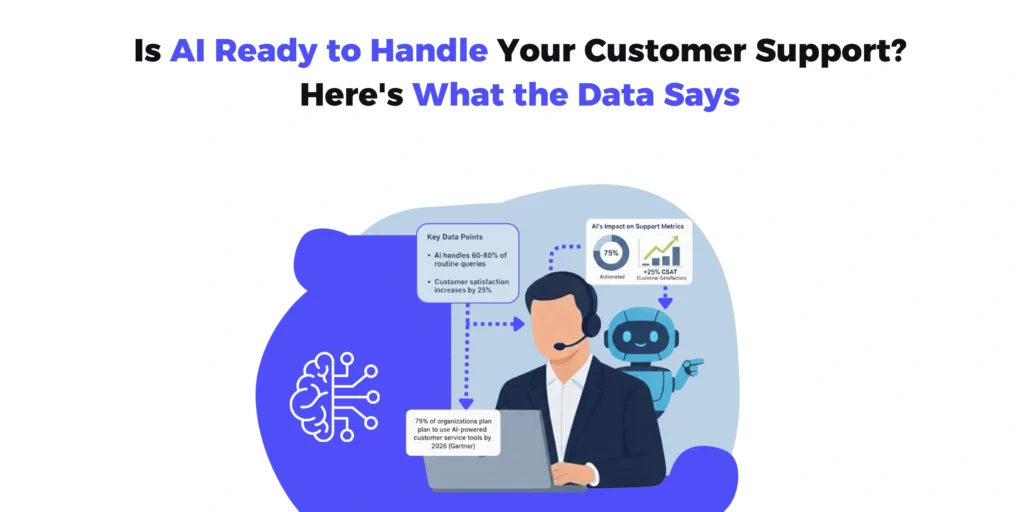
In today’s always-on economy, one statistic speaks volumes: 79% of organizations already use or plan to use AI-powered customer service tools by the end of 2026 (Gartner). That number’s not just impressive- it’s telling. As customer expectations soar, especially for 24/7 responsiveness, companies are racing to scale support operations without inflating headcount.
The problem? Human agents can only stretch so far. As demand for instant, always-available support grows, businesses find themselves caught between the need to provide seamless customer service and the limitations of traditional staffing models.
In this blog, we explore whether AI is truly ready to take on the responsibility of front-line customer interaction. We’ll dive into the latest data, contrast machine vs. human performance, and share real-world success stories, along with some cautionary tales. You’ll get a clear-eyed view of AI’s strengths, its current limits, and whether now is the right time for your business to go digital with customer support.
Spoiler: AI has come a long way but just how far might surprise you.
The Current State of AI in Customer Service
AI Adoption Statistics 2025
According to Forrester’s 2025 Customer Experience Report, over 65% of customer service organizations are already using AI, with another 14% in the piloting phase. Adoption is growing at a compound annual growth rate (CAGR) of 21%, particularly in industries where high volume meets high expectations.
Investment is keeping pace. IDC reports that global spending on customer service AI software will reach $6.3 billion in 2025, up from $3.8 billion in 2022. Companies are shifting budgets toward automation and analytics-driven platforms to stay competitive in service delivery.
Popular AI Customer Service Tools
The AI toolbox has expanded rapidly, with tools tailored for almost every function:
- Chatbots and Virtual Assistants: Platforms like Intercom, Drift, and Zendesk use NLP to handle common queries instantly.
- Automated Ticketing Systems: Freshdesk and Salesforce use AI to categorize, prioritize, and route tickets more accurately.
- Voice Recognition and Sentiment Analysis: Amazon Connect and Google Dialogflow can detect emotional cues and route calls accordingly.
- Predictive Customer Service Platforms: Tools like Pega and Genesys proactively suggest solutions before users even contact support.
Industries Leading AI Implementation
- E-commerce and Retail: Fast-paced and high-volume environments have embraced chatbots and automated live chat.
- Banking and Financial Services: AI is used for fraud detection, secure authentication, and 24/7 customer support.
- Telecommunications: Automated resolution of technical queries has seen rapid deployment.
- SaaS Companies: AI assists with onboarding, tier-one support, and upselling with contextual insights.
These industries are trailblazing, and the rest are catching up.
AI vs Human Customer Service: What the Data Reveals
Response Time Comparison
Speed is where AI shines brightest. The average response time for AI-powered chats is under 1 second, compared to 45 seconds to 2 minutes for human agents during peak hours, according to HubSpot’s 2024 Service Benchmark.
In terms of satisfaction, quick answers matter. Salesforce notes that 64% of customers rate fast response time as the top factor in a positive experience, and AI checks that box every time.
During peak periods, AI systems maintain consistency, handling surges without burnout, quite unlike human teams who may face cognitive overload.
Resolution Rate Analysis
But what about solving the problem, and not just answering fast?
According to IBM’s Global AI Study, AI-driven support resolves 62% of tier-one tickets on first contact, compared to 74% for human agents. However, when integrated with a smart escalation system, AI-human hybrids achieve over 80% resolution rates.
AI handles structured, repetitive issues excellently- think password resets or delivery status. But nuance? That still often needs a human touch.
Cost Efficiency Metrics
The economics of AI are compelling. Deloitte estimates that AI reduces customer service costs by 30%, largely by handling volume without proportional headcount increases. The cost per interaction for AI is as low as $0.25, compared to $6 to $12 for a human agent (Zendesk).
Still, there are hidden costs: data training, integration, ongoing maintenance, and occasional brand damage if automation misfires. Smart planning is essential to realize true ROI.
Customer Satisfaction Scores
Customer satisfaction (CSAT) is the ultimate scorecard. A 2024 study by Freshworks found:
- AI-handled interactions average CSAT scores of 3.9/5
- Human-handled interactions average 4.2/5
- Hybrid AI+human models average 4.4/5
Customer preferences vary by demographics. Gen Z and Millennials are more accepting of AI, while ‘Boomers’ or Gen X prefers human empathy. But the gap is narrowing as AI becomes more context-aware and less robotic.
Key Benefits of AI in Customer Service (Backed by Data)
24/7 Availability Impact
Never sleeping and never sick, AI delivers round-the-clock support. Businesses using AI for 24/7 help have reported 25% higher customer satisfaction and a 40% decrease in missed queries (Oracle CX Trends Report 2025).
For global brands, multilingual bots extend service to non-English speakers effortlessly, unlocking new market potential.
And wait times? Forget them. AI systems resolve routine issues immediately, reducing average wait time by 60–70%.
Scalability and Volume Management
During Black Friday or product launches, AI steps up. One telecom giant reported a 3X increase in service tickets during peak periods, but maintained average resolution times by offloading 65% of queries to bots (case data from Genesys).
This scalability not only saves money but it also shields your human team from burnout, enabling better focus on high-value queries.
Consistency and Accuracy
AI follows instructions perfectly. That means no emotional swings, no skipping steps, no miscommunication. Companies report error reductions of 30–45% post-AI deployment (McKinsey), especially in processes requiring strict compliance.
With centralized knowledge bases and decision trees, AI ensures every customer gets the best version of your brand every time.
Data-Driven Insights
AI doesn’t just answer- it learns. Over time, systems identify patterns in customer behavior, predict problems before they escalate, and tailor recommendations.
This analytical power enables personalization at scale. Tools like Salesforce Einstein can tailor responses based on previous interactions, raising customer loyalty by 12% (Salesforce 2024 CX Study).
Real-World Performance: Case Studies and Statistics
Success Stories
Company A: Shopify-powered DTC Brand
Using Zendesk’s AI bot, they automated 70% of support tickets. CSAT jumped from 3.8 to 4.3 in 6 months, and human agent workload dropped by 45%.
Company B: Mid-size Bank
Faced integration challenges with legacy systems, but saw a 28% cost reduction and halved onboarding time with a phased AI rollout. Emotional queries were routed to human agents via sentiment analysis.
Company C: SaaS Platform
Adopted a hybrid model: AI handled onboarding FAQs while complex user issues went to humans. They saw resolution time fall by 35% and subscription renewal rise by 12%.
Industry Benchmarks
According to Gartner, the average AI implementation timeline is 3–6 months for chatbot solutions, and up to 12 months for end-to-end AI support systems. Success rates vary:
- 73% of firms report moderate-to-high success
- 19% face integration delays or model training issues
- 8% abandon due to unclear strategy or customer backlash
Recovery strategies include pilot programs, iterative feedback loops, and human-AI collaboration.
Performance Metrics Breakdown
- Customer satisfaction improvements: +15% average for AI-supported service
- Cost reduction: Up to 35% with scaled AI support
- Efficiency gains: 40–60% increase in ticket handling capacity during peak hours
Limitations and Challenges: Where AI Falls Short
Complex Problem Solving
AI still stumbles with nuance. Legal, emotional, or multi-departmental issues often require human reasoning. For example, handling a product defect with legal implications or a frustrated customer threatening churn requires empathy and discretion.
AI’s emotional intelligence is improving, but its not yet human-grade.
Technical Limitations
Smooth AI implementation hinges on good data. Inaccurate, outdated, or siloed databases can lead to incorrect answers or system failure.
Integration with CRMs, ERPs, and ticketing tools also takes time and expertise. Maintenance? Not optional. AI needs periodic updates to stay relevant and accurate.
Customer Experience Concerns
Some customers still feel uneasy talking to “machines.” A 2025 Pew Research report found that 31% of customers over 50 prefer human interaction, while only 11% of Gen Z feel the same.
Also, transparency matters. Customers expect to know when they’re talking to AI and how to escalate to a human if needed.
The Future of AI Customer Support: Trends and Predictions
Emerging Technologies
- Advanced NLP will enable smoother, more conversational interactions.
- Emotional AI aims to recognize frustration or delight and respond accordingly.
- IoT Integration will allow AI to diagnose issues directly from connected devices- think smart fridges or wearable tech.
Market Projections
The AI customer service software market is forecasted to reach $14.9 billion by 2029, growing at a CAGR of 22% (Statista). Investment is flowing into platforms that combine analytics, conversational AI, and self-service capabilities.
Expect future systems to be smarter, faster, and even more human-like.
Making the Decision: Is Your Business Ready for AI Customer Support?
Readiness Assessment Framework
Before jumping in, ask:
- Do you receive a high volume of tier-one, repeatable queries?
- Can your budget support setup, integration, and ongoing training?
- Is your technical infrastructure cloud-ready and API-friendly?
- Will your customer base respond well to AI? Run surveys or trials first.
Implementation Recommendations
- Start small with a phased rollout and test on internal FAQs or low-risk channels.
- Consider a hybrid model, where AI assists but doesn’t replace your team.
- Measure success via KPIs like CSAT, resolution time, and deflection rate.
Conclusion
Key Takeaways: Customer service AI is no longer in the future- it’s real. With quicker times of response, cost benefits, and scalable consistency, the argument for AI is more compelling than ever.
Balanced Perspective: AI is not perfect. It doesn’t have emotional resonance and can struggle with nuance. But as a team member, not a substitute- it provides extraordinary value.
If your customer service is thin on the ground, then it may be time to think about AI. Pilot, test the data, and scale cautiously. Try out ContactSwing.ai with 50 free AI voice minutes to see the capabilities of AI in customer service for yourself.
Future Outlook: AI is only going to become smarter, more compassionate, and more ubiquitous. The question isn’t whether AI is ready- it’s whether you are.
Frequently Asked Questions (FAQs)
1. Can AI fully replace human customer support agents?
Not yet. Although AI can effectively manage routine questions and expand business efficiently, nuanced or emotionally charged matters are still improved by human interaction. The ideal approach frequently lies in a hybrid model.
2. How much does AI cost to implement in customer support?
Prices differ by platform and scale. Simple chatbot platforms can begin at $1,000–$5,000, while enterprise systems easily cost over $100,000 per year. ROI is visible for most companies within 6–12 months due to decreased support expenses.
3. Is AI customer support secure and compliant?
Yes, provided that it is done properly. The majority of top platforms provide encryption, GDPR/CCPA compliance, and role-based access controls. Nonetheless, businesses should review AI tools for data security and privacy standards prior to integration.
4. How much time does it take to put in an AI support system?
Tier-one automation tools and chatbots can be implemented in 2–8 weeks. Systems that are more sophisticated and integrate with a CRM or voice AI can take 3–6 months based on complexity and internal resource.
5. Will customers know they’re talking to a bot?
Best practice is to disclose that the interaction is AI-powered. Transparency improves trust, and many platforms include smooth handoff options to human agents when needed.